Cloud Solutions · Baulkham Hills
Cloud Solutions Baulkham Hills: SharePoint Information Architecture
Build shared cloud storage around the way your team finds and uses information. Plan SharePoint sites, document ownership and access before importing old folders.
No lock-in · Sydney-based engineers · Response <4h

<4h
Response SLA
Priority response in Baulkham Hills
99.9%
Uptime Target
SLA-backed availability
0
Lock-In Contracts
Cancel anytime, no penalties
100%
Australian Team
Local engineers, no offshore
Technology partners and platforms we work with


What we deliver
Cloud Solutions that works while you do.
Everything your Baulkham Hills business needs — managed as one seamless service with a fixed monthly price and guaranteed response times.
Last updated: 12 October 2026
Start with the questions staff ask about documents
SharePoint planning for a Baulkham Hills business should begin with how people locate the right information. Ask staff where they find an approved form, how they identify a current project document and who decides whether a file can be shared. These questions reveal the structure the business needs. A large upload into a new site may change the storage platform without improving any of those tasks. OnIT's cloud services include SharePoint setup and governance to support this planning.
Collect a small set of real document journeys rather than every folder name at once. Follow an enquiry through its working files, review steps and final record. Note when a person changes team or when an external party joins the process. The resulting map shows where documents share a purpose and where they require different handling. Keep it understandable to the people who own the work; an architecture that only an administrator can explain will be hard to maintain.
Choose site boundaries that have business owners
A site needs a clear reason to exist and someone who can make decisions about it. That reason might be a department, a project or a defined collaboration activity. Compare the intended membership and sensitivity before combining unrelated work. If one area needs tightly restricted material and another needs frequent external collaboration, ask whether placing them together creates unnecessary permission complexity. Avoid assuming that the old server's top-level folders are automatically the correct site boundaries.
Name an owner and a backup contact for each proposed site. Define what belongs there, what should live elsewhere and how new requests are approved. Keep a short description available to staff so they can choose the right destination without asking IT every time. Review sites that have no active sponsor before creating them. Empty or abandoned spaces can later attract documents simply because someone remembers the link, undermining the structure the business intended to establish.

Make naming and document labels useful in daily work
Agree names that users recognise and can distinguish from similar work. A project reference may matter more than a marketing title that changes every month. Consider which document attributes help people filter or search: work area, status, owner or a business reference. Use only labels that someone can maintain. Requiring unnecessary detail at every save can encourage staff to bypass the shared process or choose arbitrary values just to finish their task.
Test the proposed language with a person who did not design the structure. Ask them to place a sample file and retrieve it again using a different route. Check whether names make sense without the original author's explanation. Record ambiguous terms and resolve them before importing a large library. The goal is consistent decisions rather than a perfect taxonomy. A few meaningful distinctions, applied reliably, often make ownership and retrieval clearer than an elaborate set of categories nobody trusts.
Map access without turning every folder into an exception
Describe who needs to read, contribute, approve and administer each collection. Where those groups differ, make the difference deliberate and visible. Review external access as its own decision, including which documents may be shared and who can approve an invitation. Do not copy a confusing historical permission structure solely because it already exists. Ask the business owner to confirm the intended access using recognisable roles, then have the technical design assessed against that requirement.
Use representative accounts to test both allowed and denied actions. Someone should be able to open the documents needed for their job while remaining unable to reach unrelated sensitive material. Include people who belong to several teams, because overlapping membership can produce surprising results. Record exceptions with a reason and review owner. If many exceptions are needed, reconsider the site boundary rather than accepting an arrangement that future owners cannot explain or safely change.

Pilot retrieval, collaboration and document authority
Choose a bounded collection for a pilot, with active users and a sponsor who can make decisions promptly. Include an ordinary working document, an approved record and a file that moves between people. Ask users to find the current version, make an authorised change and recognise where final material belongs. These checks show whether the architecture supports work rather than simply storing it. Note device or application behaviours that need separate support from the information design.
Agree what makes the pilot acceptable before extending it. Useful evidence includes task completion, resolved permission gaps and an owner-approved placement guide. Capture abandoned links and old locations that might confuse users after the move. Explain which source becomes read-only and where people should send uncertain documents. A migration that leaves two apparently authoritative stores invites divergent copies. The sponsor should be able to identify the accepted destination and describe how corrections will be handled during transition.
Keep the structure workable after the first rollout
For a Baulkham Hills planning session, bring a sample folder map, the main document types and the people responsible for each work area. OnIT's cloud solutions service can scope SharePoint setup around that evidence. Discuss how the proposed structure handles new projects, site closure and staff changes. An information architecture needs a change process as well as an initial diagram, because the business will add work that the first design did not anticipate.
Agree who reviews unused sites, updates placement guidance and handles access requests. If these tasks are part of ongoing managed IT, make their boundaries explicit. Retain the pilot results and design decisions with the operating documentation. Your team should be able to explain where a document belongs, who owns it and how another authorised person can find it. That everyday clarity is the test of the shared storage design as the business grows and its work changes.
Quick Facts
“For Baulkham Hills businesses, cloud solutions isn't just about keeping things running — it's about building a technology foundation that drives growth across Hills District.”
— OnIT Solutions, Hills District
What's included
Cloud Solutions in Baulkham Hills. One team.
Microsoft 365 Management
Full lifecycle management of Exchange, Teams, SharePoint, and OneDrive — deployment, security, and optimisation.
Azure Cloud Infrastructure
Design, deploy, and manage Azure environments tailored to your workloads — VMs, networking, and storage.
Zero-Downtime Migrations
Move from on-prem or legacy cloud to Microsoft 365 and Azure with zero disruption to your team.
Cloud Security & Compliance
Entra ID, conditional access, Defender, and MFA — enterprise security configured for your environment.
Service detail
Your entire cloud, one team
Licence management, user provisioning, Teams, SharePoint, Exchange, and Intune — your entire Microsoft ecosystem managed.
Virtual machines, storage, networking, and Azure AD — designed, deployed, and maintained to best-practice standards.
Lift-and-shift or full re-architect migrations from on-premise to Azure or Microsoft 365 — zero downtime, fully tested.
EC2, S3, RDS, Lambda, and CloudFront — multi-cloud architectures built for performance, cost, and compliance.
Defender for Cloud, conditional access, MFA, and Entra ID — enterprise security posture maintained across your cloud estate.
Automated cloud backup with point-in-time restore. DR runbooks tested annually — RTO and RPO targets met.
Monthly licence and resource reviews to eliminate waste — reserved instances, right-sizing, and savings plan recommendations.
Uptime, performance, and security alerts across your cloud — issues detected and actioned before they impact the business.
Why OnIT
Everything in one cloud service
One provider. One invoice. Microsoft 365, Azure, migrations, and security — all managed.
Full cloud visibility
Monitor licences, usage, and spend across your Microsoft cloud — with monthly reviews to optimise costs.
Microsoft cloud specialists
Microsoft 365, Azure, Exchange, Teams, SharePoint, Entra ID — your entire Microsoft ecosystem, fully managed.


Sydney-based cloud team
Local cloud engineers across Greater Sydney. On-site workshops, remote support, and 24/7 monitoring.
Cloud security baseline
Defender, MFA, conditional access, and Entra ID — enterprise security configured and maintained by our team.




Technology Ecosystem
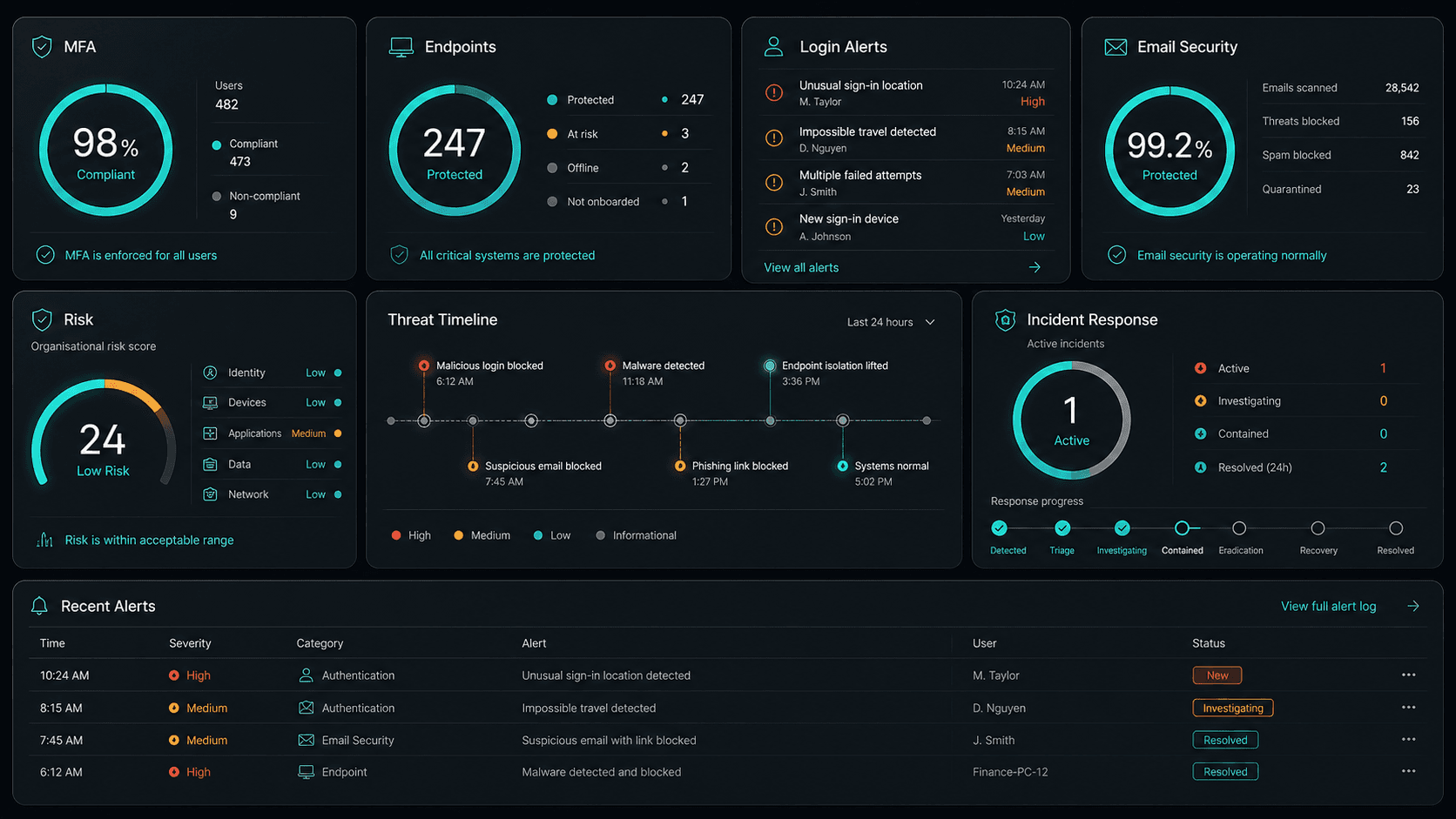
Powered by Enterprise Technology
A constellation of best-in-class platforms, deployed and managed as one seamless service.
Service Breakdown
What's inside your plan
Click any card to see exactly what's included in each service area.

Cloud Solutions that scales from 5 to 200 seats, across every Hills District business.
Why OnIT Solutions
Your Baulkham Hills business, without the overhead.
Serving Baulkham Hills (2153) and the broader Hills District area — our Sydney-based engineers understand the Hills District business community and are reachable when you need them. Whether you're a 5-person team or a growing operation with 200 seats, we scale cloud solutions to fit.
By the numbers
Measurable outcomes, guaranteed in writing
No surprise invoices. No waiting on hold. No different technician every time you call.
At a Glance
Included in your plan
Got questions?
Frequently asked questions
Also serving nearby
Cloud Solutions across Hills District
Explore further
Related services for Baulkham Hills
Cybersecurity
Threat monitoring, Essential Eight compliance, and endpoint detection — keeping your business secure around the clock.
IT Support Sydney
On-demand helpdesk and on-site support for your team. Fast response, local engineers, no lock-in contracts.
AI Automation
Workflow automation, AI chatbots and voice agents that reduce admin and free your team to focus on growth.

Get started
Ready for better Cloud Solutions
in Baulkham Hills?
Book a free cloud solutions assessment with one of our Sydney-based engineers serving Baulkham Hills and Hills District. No lock-in, no obligation.
No lock-in contracts · Sydney-based engineers · Same-day response