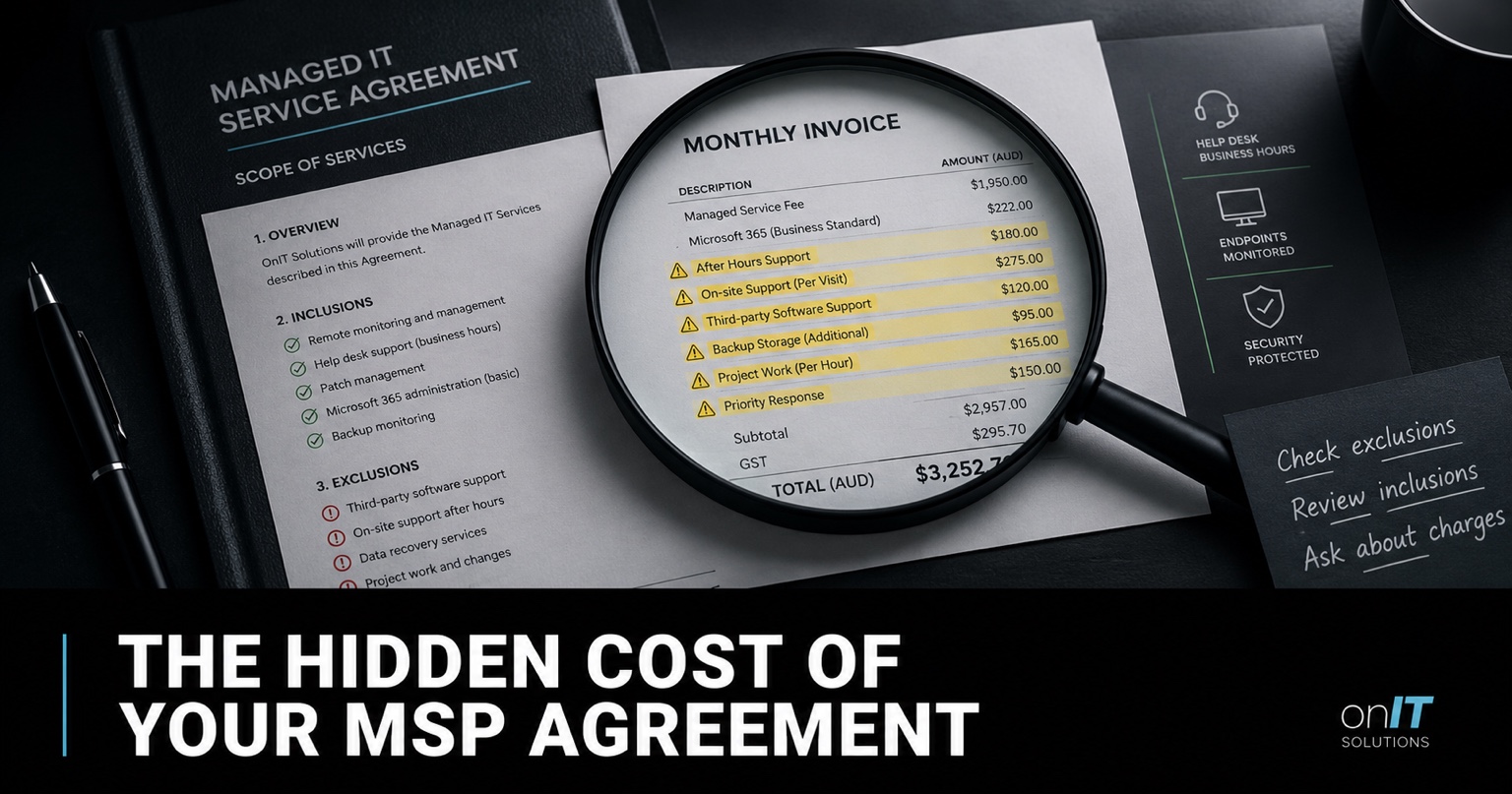
A managed service provider agreement should make IT support easier to budget and easier to understand. Yet many businesses discover that a fixed monthly fee does not produce a predictable annual cost. The difference is usually hidden in exclusions, loosely defined responsibilities and work that becomes billable only after a problem appears.
That does not mean every additional charge is unreasonable. Projects, major migrations and out-of-hours emergencies may legitimately sit outside a support plan. The concern is a contract that makes normal operational work difficult to identify, price or measure. When the service boundary is unclear, the business cannot compare providers fairly or determine whether the agreement is delivering value.
If you are assessing the real cost of an MSP agreement, start with the service model rather than the invoice total. A well-structured managed IT service should explain what is managed, how performance is reported and who owns each important risk.
1. “Managed IT” is not clearly defined
Broad wording such as “general IT support” sounds reassuring but says little about the work included in the monthly fee. A useful agreement should make common activities explicit: Microsoft 365 administration, user onboarding and offboarding, endpoint patching, network management, backup monitoring, vendor coordination, onsite visits and security reviews.
Ambiguity creates two problems. First, routine requests can become unexpected project charges. Second, important work may not happen because both parties assume the other is responsible. A firewall rule, a new laptop build or a Microsoft 365 policy change can remain unresolved while the provider and client debate whether it is included.
Questions that expose an unclear boundary
- Which users, devices, servers, sites and cloud services are covered?
- What counts as standard support, a project or a chargeable change?
- Are onsite and after-hours requests included, capped or billed separately?
- Who manages third-party vendors, warranties and internet providers?
- Which security and backup tools are included in the quoted fee?
If the provider cannot answer those questions in plain language, the headline price cannot be treated as the real price.
2. The pricing model no longer matches the business
Most providers charge per user, per device or through a hybrid model. Each can be fair, but the correct model depends on how the business operates. Per-device pricing can rise quickly when employees use a laptop, desktop, phone and shared workstation. Per-user pricing can be inefficient for seasonal staff, shift workers or shared operational accounts.
A model that suited the company two years ago may no longer fit after growth, hybrid work or a move into cloud applications. Use the practical comparison in our guide to per-user versus per-device MSP pricing, then compare the result with the provider’s current device and licence inventory.
Transparent managed IT pricing should show the unit being charged, what changes the monthly total and how additions or removals are reconciled. Ask for a current list of billable users and devices, then test it against payroll, Microsoft 365 and endpoint-management records.
3. Security is treated as an optional add-on
Modern managed IT is not only a helpdesk. Identity protection, multi-factor authentication, endpoint security, patching, email controls, backup monitoring and administrator-account hygiene are normal parts of operating a reliable environment. If those controls are absent or sold only after an incident, the apparent saving may be an unmanaged business risk.
This is especially important in Microsoft 365. Licences can provide useful security capabilities, but settings still need to be configured, monitored and reviewed. A provider should be able to explain which controls are active, what is not covered and what evidence supports that answer. A separate cybersecurity review may be appropriate where the current agreement concentrates on reactive support.
Look for ownership, not a list of products
A long tool list does not prove that risks are being managed. The agreement should identify who reviews alerts, who responds, what happens outside business hours and how unresolved risks are raised to management. Without ownership, security products can create cost without creating assurance.
4. Reporting measures activity instead of outcomes
Ticket counts are useful operational data, but they do not show whether the environment is becoming more stable, secure or efficient. A provider can close hundreds of tickets while recurring faults, stale accounts and ageing hardware remain untouched.
Useful reporting should connect technical work to decisions. It should show recurring incidents, patch and backup status, service-level performance, security recommendations, upcoming renewals, ageing equipment and work that needs a budget. It should also distinguish completed improvements from risks the business has consciously accepted.
| Weak reporting | Decision-ready reporting |
|---|---|
| Tickets opened and closed | Recurring causes, resolution trends and prevention work |
| Backup job succeeded | Restore testing, recovery time and unresolved coverage gaps |
| Devices monitored | Patch compliance, unsupported systems and replacement priorities |
| Security alerts received | Material incidents, response actions and outstanding risk decisions |
5. The relationship is still reactive
A monthly managed service should not feel like break-fix support with a subscription. If contact occurs only when someone raises a ticket, there may be little proactive management happening behind the scenes. Licences remain assigned, leavers retain access, devices miss patches and recurring problems continue because nobody is accountable for improvement.
Proactive service does not mean every problem disappears. It means there is a visible rhythm of review, maintenance, risk treatment and planning. The provider should bring recommendations before a failure forces the conversation.
Calculate the total cost before renewing
Review twelve months of invoices alongside the contract. Add the base fee, projects, after-hours charges, onsite work, licence margins and internal time spent coordinating unresolved issues. Then consider the cost of gaps: failed restores, weak access controls, unplanned downtime and projects delayed because documentation is missing.
- Confirm the current list of users, devices, sites and services.
- Separate recurring fees from variable and project charges.
- Map every important operational and security responsibility.
- Compare promised service levels with actual response and resolution data.
- Record the improvements delivered during the contract term.
Before signing another term, use our detailed list of questions to ask before renewing an MSP agreement. If the answers remain unclear, an obligation-free MSP Switch Review can provide an independent view of coverage, risk and likely transition requirements without committing you to change providers.
Record the result in a one-page comparison that management can revisit. Include the expected annual fee, likely variable work, material exclusions, outstanding risks and the improvements promised for the next term. This prevents the decision from being reduced to a monthly number after the detailed review has finished.
Frequently asked questions
What are the most common hidden costs in an MSP agreement?
Common hidden costs include project labour, after-hours support, onsite visits, new-device setup, licence mark-ups, security tools and work that sits outside a vaguely defined support boundary. The important test is whether the agreement names each inclusion, exclusion and rate clearly enough for a non-technical decision-maker to understand.
How often should an MSP agreement be reviewed?
Review the agreement at least annually and whenever the business changes materially, such as after rapid hiring, a move to hybrid work, a cloud migration, an acquisition or a major security incident. The service and pricing model should reflect the environment you operate today rather than the one that existed when the contract was signed.
Is the cheapest MSP agreement usually the best value?
No. A low monthly fee can become expensive when routine work is excluded, while a higher fee can still be poor value if security, reporting and proactive improvement are weak. Compare total annual cost, service coverage, risk ownership and measurable outcomes instead of comparing the headline fee alone.
Final perspective
The real cost of an MSP agreement is the combination of fees, exclusions, internal effort and unmanaged risk. A good agreement makes those elements visible. It defines responsibilities, supports sensible budgeting and gives business leaders evidence that the environment is improving. If your current arrangement cannot do that, review it before the renewal deadline removes your options.