Why Australian Small Businesses Are Prime Cyber Targets
There's a persistent myth that cybercriminals only go after big companies — banks, government departments, large retailers. The reality is quite different.
The Australian Cyber Security Centre (ACSC) received approximately 94,000 cybercrime reports in the 2022–23 financial year — roughly one report every six minutes. And around 43% of all cyber attacks specifically target small businesses.
Why? Because small businesses are lucrative and easy. A large bank has a dedicated security operations centre and enterprise-grade firewalls. A 10-person accounting firm in Parramatta probably has one IT person (or none), runs software that hasn't been updated since 2022, and has staff clicking on emails without much second thought. The effort-to-reward ratio is far better with small businesses.
The financial stakes are real. The average cost of a cybercrime incident for an Australian small business is over $46,000. That figure includes direct costs like ransom payments and system recovery, as well as indirect costs like lost productivity, client notification obligations, and reputational damage. For a business turning over $1–2 million a year, $46,000 is potentially business-ending.
There are also legal obligations to consider. Under the Privacy Act 1988, businesses holding personal information are required to implement reasonable security measures. The notifiable data breach scheme requires businesses to notify affected individuals and the OAIC if a breach is likely to result in serious harm.
The Most Common Cyber Threats Facing Australian SMBs
Phishing
Phishing is the single most common entry point for cyberattacks in Australia. A phishing attack tricks someone into handing over credentials, clicking a malicious link, or opening an infected file — typically via email, but increasingly via SMS and phone calls.
Modern phishing emails are convincing. Gone are the days of obviously fake messages. Today's attempts mimic ATO notifications, Australia Post delivery alerts, Xero or MYOB login prompts, and supplier invoices with perfect logos and correct grammar.
Business Email Compromise (BEC)
Business Email Compromise is a more targeted, higher-value variant of phishing. A criminal either gains access to a legitimate business email account or creates a convincing fake one, then uses it to request fraudulent payments or extract sensitive information.
The most common BEC scenario in Australia is invoice fraud: an attacker compromises a supplier's email, monitors conversations, then substitutes their own bank account details on an invoice before forwarding it. By the time anyone notices, the money is gone — usually overseas.
Ransomware
Ransomware encrypts your files and demands payment — typically in cryptocurrency — in exchange for the decryption key. Modern ransomware groups don't just encrypt data — they also exfiltrate it first and threaten to publish it if you don't pay (double-extortion).
Ransomware enters businesses via phishing emails, vulnerable remote desktop connections, and unpatched software. Healthcare, legal, and accounting businesses in Australia have been particularly hard hit due to the sensitivity of the data they hold.
Supply Chain Attacks
Supply chain attacks target your business indirectly by compromising a third-party supplier or software provider you trust. Managed service providers (MSPs) have been increasingly targeted because a single compromised MSP can give attackers access to dozens or hundreds of client businesses simultaneously — which is why vetting your IT provider's own security posture matters.
The Australian Government's Essential Eight Framework
The Australian Signals Directorate (ASD) developed the Essential Eight — the baseline cybersecurity standard recommended for all Australian organisations. It is eight specific, practical controls that, if properly implemented, would prevent the vast majority of cyberattacks targeting Australian businesses.
1. Application Control
What it is: Only allow pre-approved software to run on your computers.
Why it matters: Ransomware and malware are software. If your systems will only run approved applications, malicious software cannot execute even if it lands on your machine.
2. Patch Applications
What it is: Keep your applications updated promptly — high-risk patches within 48 hours, others within two weeks.
Why it matters: Most cyberattacks exploit known vulnerabilities that the vendor has already patched. Running outdated software is a preventable risk.
3. Configure Microsoft Office Macro Settings
What it is: Disable or restrict macros in Microsoft Office documents, unless they are digitally signed by a trusted source.
Why it matters: Macros are a common delivery mechanism for malware in Australia — a staff member opens an invoice attachment, the macro runs, and ransomware is installed.
4. User Application Hardening
What it is: Configure applications to reduce their attack surface — disable features commonly exploited, like Flash, ads in browsers, and unnecessary browser plugins.
Why it matters: Web browsers are the primary attack surface for most staff. Restricting what browsers can run significantly reduces exposure.
5. Restrict Administrative Privileges
What it is: Only give staff the level of access they actually need. Don't let everyone be an administrator.
Why it matters: If a standard user account is compromised, the attacker can only do what that user can do. If an admin account is compromised, the attacker can do anything.
6. Patch Operating Systems
What it is: Keep your operating systems — Windows, macOS, iOS, Android — updated promptly.
Why it matters: Like application patching, OS patches fix known vulnerabilities. Any device that connects to your business systems should be running a supported, up-to-date OS.
7. Multi-Factor Authentication (MFA)
What it is: Require a second form of verification — beyond just a password — to access systems.
Why it matters: Passwords alone are insufficient. They get stolen in phishing attacks, reused across sites, and exposed in data breaches. MFA means that even if an attacker has your password, they cannot log in without your second factor. This single control prevents a huge proportion of account takeover attacks.
8. Regular Backups
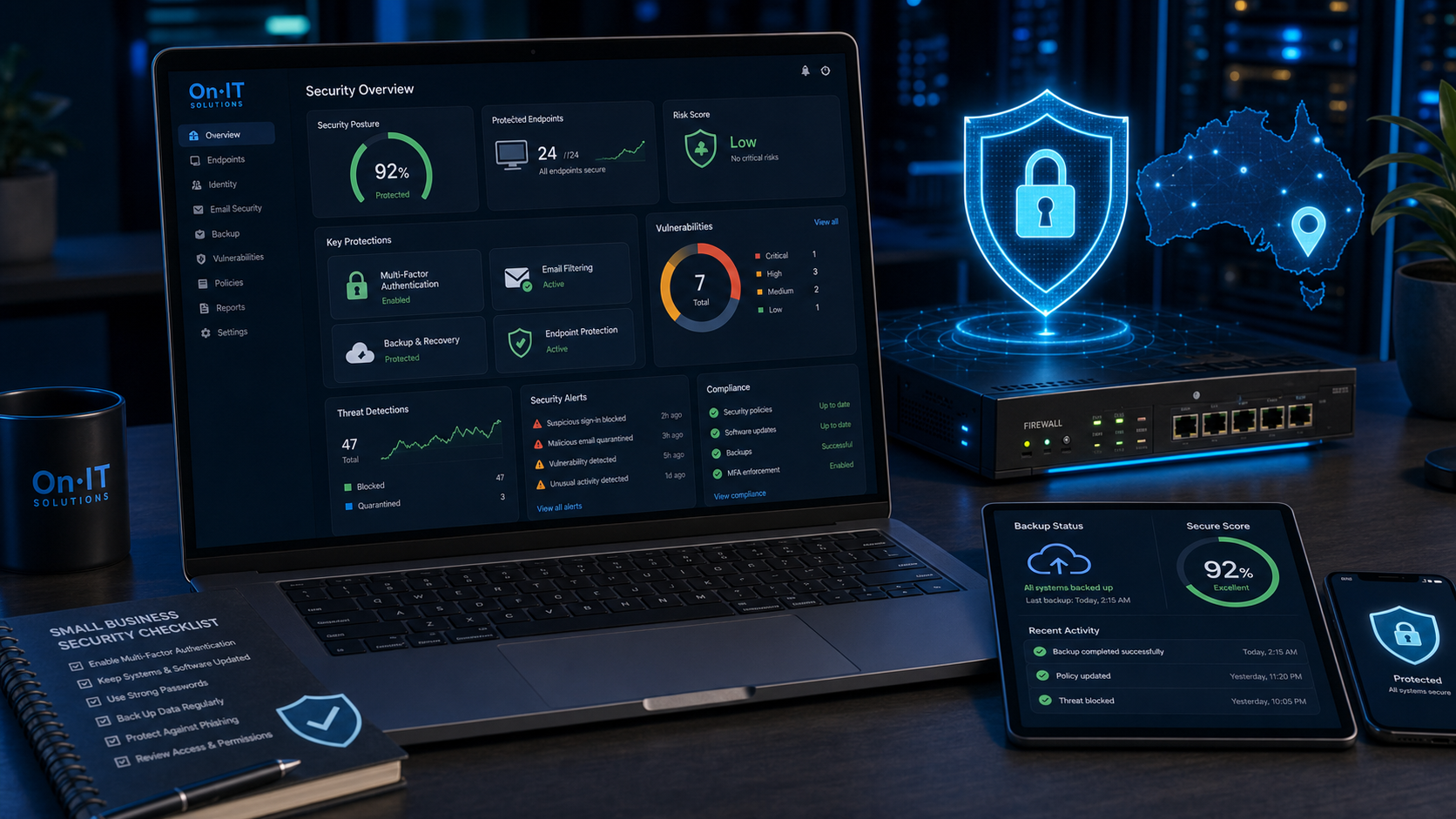
What it is: Back up your data regularly, keep multiple copies, test that you can actually restore from them, and keep at least one copy offline or isolated from your main systems.
Why it matters: Backups are your last line of defence against ransomware. Follow the 3-2-1 rule: three copies of your data, on two different media types, with one copy offsite. Test your restore process quarterly.
Learn how OnIT Solutions implements the Essential Eight for Sydney businesses →
Cybersecurity for Specific Industries
Medical and Healthcare Practices
Medical practices hold some of the most sensitive personal information that exists: patient health records, Medicare details, prescription histories, mental health notes. Under the Privacy Act and the My Health Records Act, healthcare providers have strict obligations around data security. Patient data is extraordinarily valuable on dark web marketplaces, and ransomware groups specifically target healthcare because downtime creates pressure to pay quickly.
Cybersecurity and managed IT for medical clinics →
Legal Practices
Law firms hold highly confidential client information — commercially sensitive, legally privileged, and subject to strict professional obligations. Targeted BEC attacks aimed at redirecting client trust account payments are increasingly common. Key priorities include protecting trust accounts with MFA, email security to detect BEC attempts, and clear policies around client document handling.
IT security solutions for law firms →
Accounting Firms
Accountants hold a perfect storm of valuable information: tax file numbers, bank account details, payroll data, company financials. The ATO has been explicit: tax agents and BAS agents are high-value targets. Key priorities include ATO-recommended security controls for the Tax Agent Portal, strict MFA on all financial platforms, and a clear process for verifying bank account change requests.
Managed IT and cybersecurity for accounting firms →
Trades and Field Service Businesses
Tradies typically hold customer payment details, run job management software, and have subcontractors accessing shared systems with minimal oversight. Invoice fraud is particularly effective in trades because payment amounts are often large. Key priorities include a password manager for the whole team, MFA on cloud job management platforms, and a verified process for handling any payment detail changes.
How to Build a Cybersecurity Plan for Your Business
Step 1: Understand What You're Protecting
Start with an inventory. What data do you hold? Where does it live — on local servers, in cloud apps, in staff laptops? Who has access to it? You can't protect what you don't know you have.
Step 2: Identify Your Biggest Risks
Given your industry, your data, and your current setup, where are you most exposed? Rank your risks and start with the controls that give the most protection per dollar spent. MFA is typically at the top of this list because it is low cost and high impact.
Step 3: Implement the Foundational Controls First
Before worrying about advanced security tools, make sure the basics are in place:
- MFA enabled on all critical systems (email, accounting software, cloud storage, remote access)
- All devices running up-to-date operating systems and applications
- A reliable, tested backup solution with at least one offsite or offline copy
- Staff using unique, strong passwords managed via a password manager
- Administrative privileges restricted to those who genuinely need them
These five controls alone will stop the vast majority of attacks targeting Australian SMBs.
Step 4: Train Your Team
Your staff are both your greatest vulnerability and your first line of defence. At minimum: run a phishing simulation to see who clicks, teach staff what phishing emails look like and what to do when they suspect one, establish a "verify before you pay" rule for any bank account changes, and make it safe to report suspected incidents without blame.
Step 5: Create a Simple Incident Response Plan
A basic incident response plan answers these questions before you're in the middle of a crisis: who is the internal coordinator, who is your IT provider's emergency contact, what is the isolate-and-preserve process, what are your notification obligations, and what is your client communication plan.
Step 6: Review Annually
Set a calendar reminder to review your security posture annually — update your risk assessment, check that controls are still working, and review any incidents or near-misses from the past year.
Managed IT services that include proactive cybersecurity monitoring →
What to Look for in a Cybersecurity Provider
They Explain Things Without the Jargon
A good provider talks to you like an adult who runs a business. If your provider can't explain what they're doing and why in plain English, that's a red flag.
They Know the Australian Landscape
Australian businesses face specific obligations under Australian law — the Privacy Act, the notifiable data breach scheme, the My Health Records Act, the ATO's security requirements. Your provider should understand these, not just generic best practices.
They Have a Proactive Approach
Reactive IT support is not cybersecurity. A good provider monitors your systems proactively, identifies vulnerabilities before they're exploited, and patches things without waiting for you to call.
They Offer Transparent Pricing
OnIT Solutions offers managed IT services — which include cybersecurity monitoring, patching, backup management, and support — starting from $95 per user per month, with no lock-in contracts. Be wary of providers who use fear to upsell you on services you don't need.
FAQ
How much does cybersecurity cost for a small business in Australia?
At the foundational level, many businesses can get started for a few hundred dollars per month. A fully managed cybersecurity service from OnIT Solutions starts from $95 per user per month, which includes proactive monitoring, patching, backup management, and support. This is far less than the average $46,000+ cost of a cybercrime incident.
Do I need to comply with the Essential Eight if I'm a small business?
The Essential Eight is mandatory for non-corporate Commonwealth entities but is not legally compulsory for private sector small businesses. However, it is the standard by which "reasonable" cybersecurity is increasingly judged by regulators and cyber insurers. Implementing at least a Maturity Level 1 posture is strongly recommended for any business holding customer or employee data.
What should I do immediately if I think I've been hacked?
Isolate the affected device by disconnecting it from the internet and your network. Call your IT provider immediately. If financial data may have been compromised, contact your bank. If personal information of clients or employees may have been accessed, you likely have notification obligations under the Privacy Act. Report the incident at cyber.gov.au/report.
Is cyber insurance worth it for a small business?
Cyber insurance is increasingly worth considering for businesses that hold sensitive client data. Get your foundational security controls in order first — many insurers now require evidence of MFA and baseline controls before providing coverage — then assess insurance as an additional layer.
How do I know if my staff are a cybersecurity risk?
Run a phishing simulation: send a realistic fake phishing email to staff and track who clicks, who enters credentials, and who reports it. This data lets you identify who needs more training without waiting for an actual attack to find out.
Conclusion
Cybersecurity is never "done." It is an ongoing process of managing risk, not eliminating it entirely. The goal is to make your business a harder target than the next one, to have the controls in place that stop the most common attacks, and to have a plan ready for when something does go wrong.
Start with the basics: MFA everywhere, keep things updated, have a real backup, train your staff on phishing. Then layer on additional controls as your risk profile and budget allow.
OnIT Solutions offers free cybersecurity assessments for Sydney businesses — we'll look at your current environment, identify your highest-priority risks, and give you a plain-English roadmap for improvement. No lock-in contracts, no hard sell.