Web Development · Kellyville
Web Development Kellyville: Establish Content Ownership
A CMS makes editing possible, but someone still needs to decide what is accurate and ready to publish. Establish content ownership and a review workflow that fits the changes your business actually makes.
No lock-in · Sydney-based engineers · Response <4h

<4h
Response SLA
Priority response in Kellyville
99.9%
Uptime Target
SLA-backed availability
0
Lock-In Contracts
Cancel anytime, no penalties
100%
Australian Team
Local engineers, no offshore
Technology partners and platforms we work with


What we deliver
Web Development that works while you do.
Everything your Kellyville business needs — managed as one seamless service with a fixed monthly price and guaranteed response times.
Last updated: 14 October 2026
Assign decisions to people who understand the content
A Kellyville business website can become difficult to maintain when everyone can request changes but nobody owns the published facts. Begin by identifying the person responsible for each major content area. Service descriptions, contact information, team profiles and downloadable resources may need different reviewers. OnIT Solutions builds CMS-based websites that allow clients to manage content. The value of that capability depends on an editorial arrangement that gives staff useful control while making it clear who can confirm accuracy and who has authority to publish.
Content ownership is a decision responsibility rather than a requirement that one person type every update. An editor may prepare the page while a service owner checks its meaning. A manager may authorise a commercial claim or a change to the business's stated process. Record those responsibilities in terms of real work, including who acts when the usual owner is unavailable. Without a substitute, a minor correction can wait indefinitely or be published by someone who assumes silence means approval.
Design permissions around the edits staff need to make
List common changes and determine which fields should be available to each editor. Updating a telephone number is different from adding a new service page or changing a shared navigation label. A CMS can expose useful content controls without giving every contributor responsibility for the entire website structure. Discuss the intended level of self-management during the build so the content model and editing screens support it. Avoid choosing permissions solely by job title if the actual publishing responsibilities cross those boundaries.
Keep administration separate from routine content work where appropriate. Staff who amend copy do not necessarily need to manage user access, plugins or hosting settings. Agree how new editors are approved and how access is removed when someone leaves. Use individual accounts rather than an undocumented shared login so responsibilities remain understandable. The operating arrangement should include a way to request help when an editor encounters a field or workflow they do not understand, rather than encouraging experiments directly on important published content.

Use an editorial workflow proportionate to the change
Define a simple path from draft to review to publication. A factual correction may need a quick check by the owner, while a new service page may require content, visual and functional review. The workflow should make those differences explicit without creating unnecessary steps for every punctuation change. Keep drafts distinguishable from published material and give reviewers a practical way to see the proposed result. A review is easier when the person can compare the changed content with its intended page context.
Require supporting evidence for claims that could mislead customers if wrong. Prices, availability, qualifications, outcomes and customer examples should have an identifiable approver and source. Do not fill missing information with plausible-sounding copy merely to complete the layout. When a fact cannot be confirmed, revise the wording or leave the unsupported statement unpublished. Keep personal information and private customer material out of routine drafts unless its use is authorised and appropriate. Content review needs to assess what the page reveals as well as how persuasive it sounds.
Check the published experience rather than only the editor
Before publication, review headings, links, image descriptions and the page's primary action. A change that looks correct in a text field may create an overlong heading, an unclear button label or a broken document link in the actual layout. Preview on a narrow screen as well as desktop when the change affects structure or media. Check the title and description fields where those form part of the publishing process. Explain their purpose to editors so they do not become a second place to repeat every keyword.
After publication, open the public destination and verify that the intended change is visible. If the site uses caching or scheduled publishing, define how editors confirm the result without guessing. Keep a record of substantial changes and the means to recover from an incorrect publication within the selected CMS and hosting arrangement. Recovery should not depend on the editor remembering the old text. Test the agreed method during handover and explain who can use it, especially when a change affects more than one page.

Maintain a review schedule tied to business change
Some content needs periodic review, while other material should be revisited when a service or operating process changes. Maintain a lightweight list of page owners, review triggers and unresolved questions. Prioritise customer-facing facts that can become wrong, such as contact routes or the scope of an offered service. An automatic date change is not a substantive content review. The owner should confirm the information, correct inaccuracies and record the decision when appropriate, rather than simply make a page appear recently updated.
For a Kellyville website, bring examples of recurring edits to OnIT's web development service and ask how the CMS and handover will support them. Agree what staff maintain independently and what requires developer assistance or an additional support arrangement. Use a short training exercise in which an editor drafts, previews, approves and publishes a realistic change. The result should be a sustainable process with clear responsibilities. A website remains useful when its content can evolve accurately after the original project team has moved on.
Quick Facts
“For Kellyville businesses, web development isn't just about keeping things running — it's about building a technology foundation that drives growth across Hills District.”
— OnIT Solutions, Hills District
What's included
Web Development in Kellyville. One team.
Custom Website Design
Bespoke designs built to your brand — no templates, no compromises. Every site is unique to your business.
SEO-First Architecture
SEO isn't an afterthought — site structure, speed, and schema are engineered for search from day one.
Core Web Vitals Optimised
Fast-loading, accessible, and mobile-first. Every site meets Google's performance standards out of the box.
CMS & Self-Management
Built on modern CMS platforms (Sanity, Contentful, WordPress) so your team can update content without a developer.
Service detail
Websites built to perform
Bespoke designs built to your brand — not templates. Every layout crafted for conversion and mobile-first performance.
Modern tech stack: Next.js, React, Tailwind CSS, and TypeScript — fast, scalable, and maintainable from day one.
Search-first structure: schema markup, canonical URLs, Core Web Vitals, and meta optimisation baked into every build.
Sanity, WordPress, or headless CMS — content your team can update without a developer.
Shopify, WooCommerce, and custom storefronts — product pages, checkout flows, and inventory integrations.
Green Core Web Vitals scores, lazy loading, image optimisation, and CDN configuration — fast on every device.
GA4, Tag Manager, conversion tracking, and heatmaps — full visibility into how visitors interact with your site.
Security patches, dependency updates, uptime monitoring, and feature development — your site stays fast and secure.
Why OnIT
Everything in one web development service
One team. One fixed scope. SEO-first design, fast delivery, and ongoing management — all included.
SEO architecture from day one
Every site is built with search in mind — page structure, meta tags, schema markup, and Core Web Vitals optimised.
Modern tech stack
Next.js, React, Tailwind, Sanity, WordPress — we build on platforms that scale with your business.


Sydney-based design team
Local designers and developers who understand your market — with face-to-face workshops available.
Fast, accessible, mobile-first
Every site scores green on Core Web Vitals — fast loading, responsive, and accessible on every device.
Service Breakdown
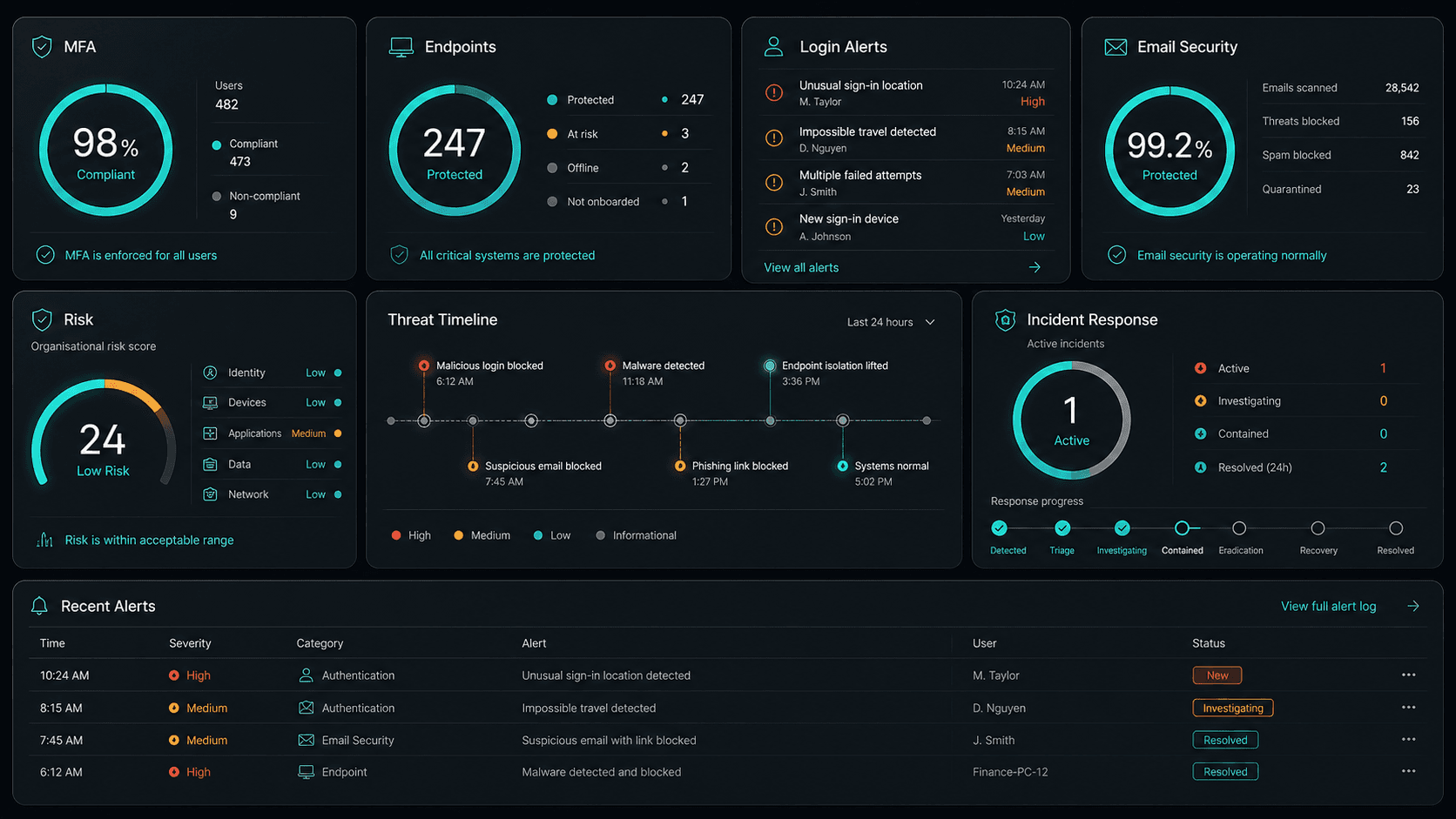
What's inside your plan
Click any card to see exactly what's included in each service area.

Web Development that scales from 5 to 200 seats, across every Hills District business.
Why OnIT Solutions
Your Kellyville business, without the overhead.
Serving Kellyville (2155) and the broader Hills District area — our Sydney-based engineers understand the Hills District business community and are reachable when you need them. Whether you're a 5-person team or a growing operation with 200 seats, we scale web development to fit.
By the numbers
Measurable outcomes, guaranteed in writing
No surprise invoices. No waiting on hold. No different technician every time you call.
At a Glance
Included in your plan
Got questions?
Frequently asked questions
Also serving nearby
Web Development across Hills District
Explore further
Related services for Kellyville
Cybersecurity
Threat monitoring, Essential Eight compliance, and endpoint detection — keeping your business secure around the clock.
IT Support Sydney
On-demand helpdesk and on-site support for your team. Fast response, local engineers, no lock-in contracts.
AI Automation
Workflow automation, AI chatbots and voice agents that reduce admin and free your team to focus on growth.

Get started
Ready for better Web Development
in Kellyville?
Book a free web development assessment with one of our Sydney-based engineers serving Kellyville and Hills District. No lock-in, no obligation.
No lock-in contracts · Sydney-based engineers · Same-day response