Cloud Solutions · Miranda
Cloud Solutions Miranda: Make File Naming Support Real Work
A naming convention should help people choose the right document and maintain it. Define the decisions names support before imposing a new code system on the shared cloud workspace.
No lock-in · Sydney-based engineers · Response <4h

<4h
Response SLA
Priority response in Miranda
99.9%
Uptime Target
SLA-backed availability
0
Lock-In Contracts
Cancel anytime, no penalties
100%
Australian Team
Local engineers, no offshore
Technology partners and platforms we work with


What we deliver
Cloud Solutions that works while you do.
Everything your Miranda business needs — managed as one seamless service with a fixed monthly price and guaranteed response times.
Last updated: 2 November 2026
Find the decisions a filename needs to communicate
A Miranda business reviewing cloud file names should begin with the confusion staff actually experience. People may need to distinguish an approved template from a working draft, identify the relevant period or find the document maintained by another team. OnIT Solutions manages Microsoft 365 collaboration services, including SharePoint and OneDrive. Use a naming discussion to support those tasks rather than make every folder look uniform. A convention is useful when it helps people choose correctly, not simply when names follow an elaborate pattern.
Collect authorised examples of mistaken selections, duplicate names and unclear versions. Ask users to explain how they search and what they expect a name to tell them. Keep the purpose of a document distinct from its location. A well-labelled item can still be unsuitable for the task, while an unfamiliar historic name may have important references. Record the actual problem before deciding what should change. This prevents a broad renaming exercise from creating broken shortcuts or extra work without addressing the original information decision.
Agree a small set of meaningful naming elements
Choose elements that ordinary maintainers can understand and apply, such as subject, approved status or a relevant business period. Avoid requiring private customer or staff details in every path unless the business has approved that need. Explain any abbreviations and test whether people unfamiliar with the internal code can interpret them. The selected cloud platform's current technical constraints should be checked separately. A practical convention should fit both the supported environment and how staff recognise their work, rather than treating either concern as sufficient by itself.
Decide which naming elements are mandatory and which add noise. A long sequence can be difficult to maintain and may repeat information already managed elsewhere. Ask owners to compare proposed names with realistic tasks before applying the convention widely. Keep exceptions visible and explain who can approve them. The goal is enough consistency to support a decision, with limits people understand. A rule that forces staff to invent unclear values can produce superficial compliance while making the shared collection harder to interpret.

Connect templates to publishing and approval ownership
Identify which documents are intended as reusable starting points and who approves their content. A filename containing template does not prove the material is current or authorised. Define the source people should use and how approved updates reach it. Keep working drafts separate through an understandable process suited to the selected platform. The business owner should decide the wording or operating requirement, while technical administration supports access and publishing. This prevents a naming convention from lending authority to a document whose content has never been reviewed.
Consider related instructions, saved links and copies distributed outside the cloud collection. A renamed template may remain available through an old reference or downloaded file. Decide which routes the project will update and explain what it cannot control. Do not claim that changing the source replaces every copy staff already hold. Give users a way to recognise the current approved version and request clarification. A publishing process should maintain the relationship between the authoritative document and the names people use to find it.
Test search, selection and ordinary editing before rollout
Use approved examples representing common documents, similar subjects and ambiguous cases. Ask users to find the correct item and explain their choice. Then have an authorised maintainer create or update a representative record using the proposed rules. Observe where the convention helps and where it requires explanation. Search behaviour and visible naming may vary across user journeys, so test the relevant interfaces rather than only an administrator's preferred view. Record the result and revise the plan where it creates avoidable uncertainty.
Include a transition example involving a renamed document and an existing reference. Verify the replacement route and identify any application or supplier dependency needing separate work. Avoid renaming critical live collections as an unrestricted test. A controlled subset can establish the process and exception handling before changes expand. If the decision exposes disagreement about ownership or status, resolve that question instead of simply finding a more polished name. Acceptance should concern a usable information journey, not how many records a script successfully renames.

Maintain conventions through ownership changes
Keep concise examples with the instructions and identify who maintains them. New staff should understand the purpose of the naming elements, not only a pattern to copy. Review the rules when a workflow or publishing arrangement changes. Assign responsibility for outdated templates and exceptions, with a practical correction route. The convention should reduce repeated decisions rather than create an approval bottleneck for ordinary files. A sample review can reveal drift without implying that every historic item must be rewritten before current work continues.
For cloud naming and template planning in Miranda, bring real selection problems and approved document examples to OnIT's cloud collaboration service. Ask for a scoped convention, ownership model and representative acceptance tests. Explain any application references affected by renaming. The desired result is a shared collection people can interpret and maintain with reasonable effort, rather than consistent filenames that still leave staff unsure which document is approved, who may update it or how to obtain the current version.
Quick Facts
“For Miranda businesses, cloud solutions isn't just about keeping things running — it's about building a technology foundation that drives growth across South Sydney.”
— OnIT Solutions, South Sydney
What's included
Cloud Solutions in Miranda. One team.
Microsoft 365 Management
Full lifecycle management of Exchange, Teams, SharePoint, and OneDrive — deployment, security, and optimisation.
Azure Cloud Infrastructure
Design, deploy, and manage Azure environments tailored to your workloads — VMs, networking, and storage.
Zero-Downtime Migrations
Move from on-prem or legacy cloud to Microsoft 365 and Azure with zero disruption to your team.
Cloud Security & Compliance
Entra ID, conditional access, Defender, and MFA — enterprise security configured for your environment.
Service detail
Your entire cloud, one team
Licence management, user provisioning, Teams, SharePoint, Exchange, and Intune — your entire Microsoft ecosystem managed.
Virtual machines, storage, networking, and Azure AD — designed, deployed, and maintained to best-practice standards.
Lift-and-shift or full re-architect migrations from on-premise to Azure or Microsoft 365 — zero downtime, fully tested.
EC2, S3, RDS, Lambda, and CloudFront — multi-cloud architectures built for performance, cost, and compliance.
Defender for Cloud, conditional access, MFA, and Entra ID — enterprise security posture maintained across your cloud estate.
Automated cloud backup with point-in-time restore. DR runbooks tested annually — RTO and RPO targets met.
Monthly licence and resource reviews to eliminate waste — reserved instances, right-sizing, and savings plan recommendations.
Uptime, performance, and security alerts across your cloud — issues detected and actioned before they impact the business.
Why OnIT
Everything in one cloud service
One provider. One invoice. Microsoft 365, Azure, migrations, and security — all managed.
Full cloud visibility
Monitor licences, usage, and spend across your Microsoft cloud — with monthly reviews to optimise costs.
Microsoft cloud specialists
Microsoft 365, Azure, Exchange, Teams, SharePoint, Entra ID — your entire Microsoft ecosystem, fully managed.


Sydney-based cloud team
Local cloud engineers across Greater Sydney. On-site workshops, remote support, and 24/7 monitoring.
Cloud security baseline
Defender, MFA, conditional access, and Entra ID — enterprise security configured and maintained by our team.




Technology Ecosystem
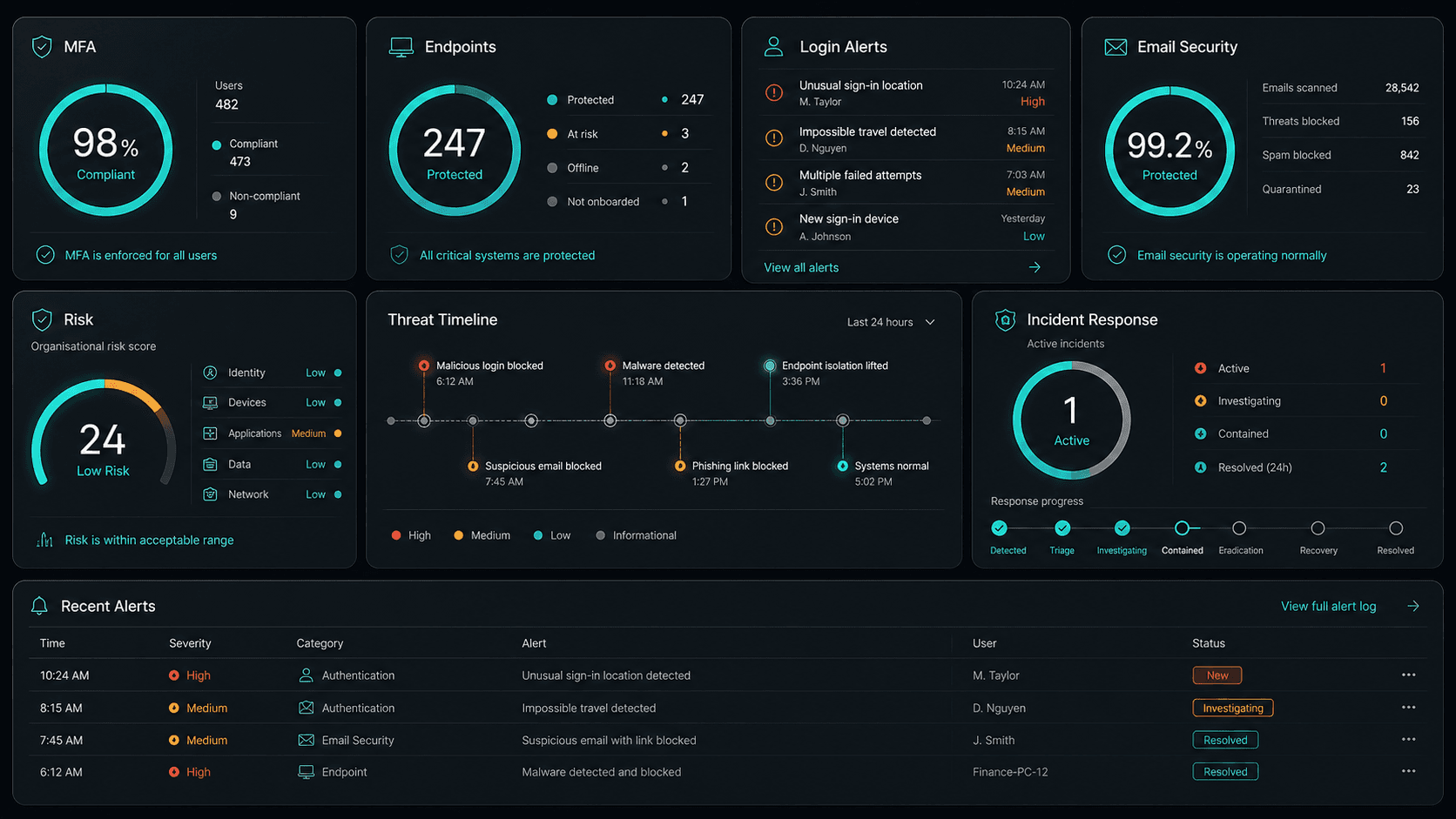
Powered by Enterprise Technology
A constellation of best-in-class platforms, deployed and managed as one seamless service.
Service Breakdown
What's inside your plan
Click any card to see exactly what's included in each service area.

Cloud Solutions that scales from 5 to 200 seats, across every South Sydney business.
Why OnIT Solutions
Your Miranda business, without the overhead.
Serving Miranda (2228) and the broader South Sydney area — our Sydney-based engineers understand the South Sydney business community and are reachable when you need them. Whether you're a 5-person team or a growing operation with 200 seats, we scale cloud solutions to fit.
By the numbers
Measurable outcomes, guaranteed in writing
No surprise invoices. No waiting on hold. No different technician every time you call.
At a Glance
Included in your plan
Got questions?
Frequently asked questions
Also serving nearby
Cloud Solutions across South Sydney
Explore further
Related services for Miranda
Cybersecurity
Threat monitoring, Essential Eight compliance, and endpoint detection — keeping your business secure around the clock.
IT Support Sydney
On-demand helpdesk and on-site support for your team. Fast response, local engineers, no lock-in contracts.
AI Automation
Workflow automation, AI chatbots and voice agents that reduce admin and free your team to focus on growth.

Get started
Ready for better Cloud Solutions
in Miranda?
Book a free cloud solutions assessment with one of our Sydney-based engineers serving Miranda and South Sydney. No lock-in, no obligation.
No lock-in contracts · Sydney-based engineers · Same-day response