Cloud Solutions · Dee Why
Cloud Solutions Dee Why: Give Service Accounts a Clear Purpose
An application account should have an explainable job and a responsible owner. Understand what depends on it before granting more access, changing its configuration or removing a departing employee's credentials.
No lock-in · Sydney-based engineers · Response <4h

<4h
Response SLA
Priority response in Dee Why
99.9%
Uptime Target
SLA-backed availability
0
Lock-In Contracts
Cancel anytime, no penalties
100%
Australian Team
Local engineers, no offshore
Technology partners and platforms we work with


What we deliver
Cloud Solutions that works while you do.
Everything your Dee Why business needs — managed as one seamless service with a fixed monthly price and guaranteed response times.
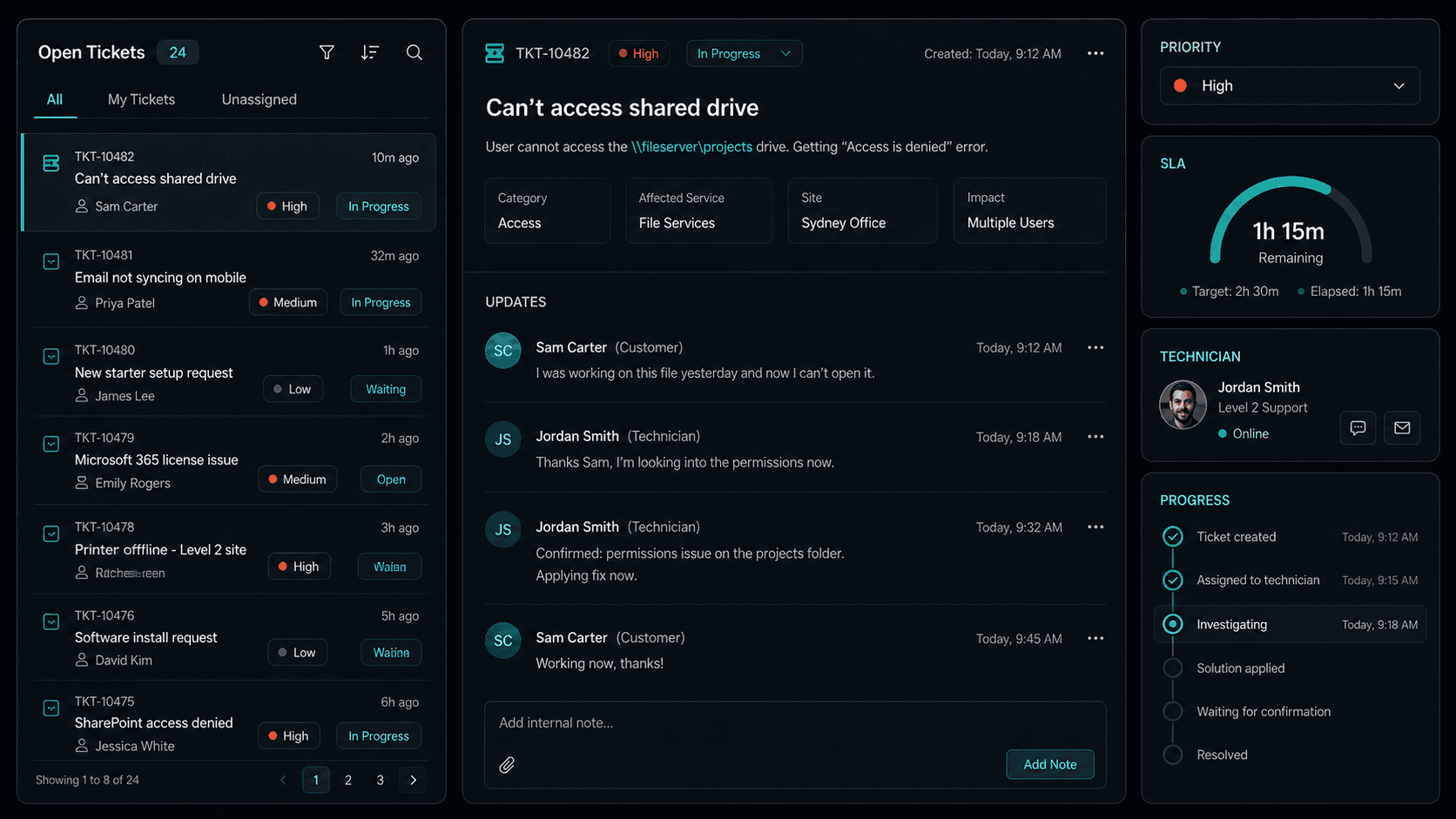
Last updated: 2 November 2026
Identify the work performed outside an ordinary staff session
A Dee Why business may have cloud tasks that run through integrations, scheduled jobs or supplier-managed connections. Their accounts can be less visible than employee logins while remaining important to daily work. OnIT Solutions provides cloud administration and Microsoft 365 management. Begin a service-account review by identifying the actual task, system and owner. Avoid assuming every unfamiliar account is unnecessary or that an account with an operational label is approved. The assessment should establish why it exists and what business result depends on its continued operation.
Ask administrators and application owners to explain the known connections, using available configuration and operating records. Identify work that currently relies on an individual's account even though it serves a shared process. Record the relationship without copying secret material into the inventory. A useful account register contains purpose, ownership, environment and support references. It does not need passwords or unrestricted application exports. Keep uncertain accounts visible for investigation rather than disabling them immediately or leaving them indefinitely because nobody wants to risk discovering what they do.
Separate business approval from technical administration
Nominate the business owner who approves the task and the operator who maintains the connection. Those roles may involve different organisations. An administrator able to create an account does not necessarily decide which information a workflow should access. Agree the intended actions and data boundary in terms the business can understand. This gives permission review a practical reference. A broad statement that the integration needs access is less useful than a description of the specific work it must read, prepare or commit within the agreed service scope.
Assess the actual account and permission options supported by the selected systems. Explain any limitation that prevents the desired separation rather than promising an arrangement the platform cannot enforce. Avoid using a person's unrestricted credentials merely to make a demonstration work. Where an existing connection has broad authority, document the gap and the approved plan for addressing it. The review should distinguish verified restrictions from operating instructions or assumptions, so the business understands which boundaries are technically enforced and which depend on oversight or another supplier's controls.

Make lifecycle events deliberate rather than accidental
Identify how the account is created, changed, recovered and retired. Staff departure should trigger a dependency review where an employee's identity supports shared work. Do not assume that deleting the person is enough or that the connection should be transferred unchanged. Agree which task remains required and what replacement arrangement is appropriate. Record who approves the change, how it is implemented and how the result is tested. A lifecycle plan should preserve useful business work without turning an old workaround into a permanently endorsed access pattern.
Discuss how sensitive configuration is maintained through the organisation's approved secure process. The handover should identify authorised owners and recovery routes without reproducing credentials in ordinary documentation. Review dependencies on supplier accounts and the business's ability to obtain legitimate assistance. An inaccessible operator can become a continuity problem even if the connected job is currently running. Keep any temporary arrangement and its review point visible. Routine ownership changes need planned verification, rather than an assumption that a new contact name on the register proves control has actually changed.
Verify the account through its approved task
Choose a controlled example of the work the account is meant to perform. Observe the relevant source, operation and destination result using authorised methods. A successful login or token check does not establish that the business task completes. Include a permission boundary that should prevent an unrelated action where it can be tested safely. Record the selected systems and limitations. The purpose is evidence about the agreed operating scope, not an unrestricted experiment with live information or a claim that one successful test establishes every possible security property.
Test a failure and the available support route. The responsible operator should be able to distinguish a stopped job from a completed task and identify the appropriate next action. Check actual destination state before retrying an operation whose result is uncertain. If an account change affects several connections, verify representative dependencies individually instead of assuming that one recovered integration proves all are restored. Keep unresolved items assigned to owners. Acceptance should show the business what continues to work, what remains unavailable and who can decide whether normal operation may resume.

Keep purpose and ownership current
Review the register when applications, responsibilities or supplier arrangements change. A previously necessary account can become obsolete while retaining access, and a new connection can create a dependency nobody records. Give operators a route for reporting unclear ownership and business owners a way to confirm continuing need. The review frequency should suit the selected arrangement and agreed service, rather than rely on a generic promise. A maintainable record makes it possible to answer a future question about the account without depending entirely on the person who originally created it.
For cloud service-account planning in Dee Why, bring known integrations and their business owners to OnIT's cloud administration service. Discuss associated security review where permission or access concerns need a separately defined assessment. Ask for a scoped inventory, verified task tests and a lifecycle plan. The useful outcome is an account with an explainable purpose, appropriate authority and an accountable owner, rather than a collection of operational logins that remain active solely because nobody knows which business process might stop if they change.
Quick Facts
“For Dee Why businesses, cloud solutions isn't just about keeping things running — it's about building a technology foundation that drives growth across Northern Beaches.”
— OnIT Solutions, Northern Beaches
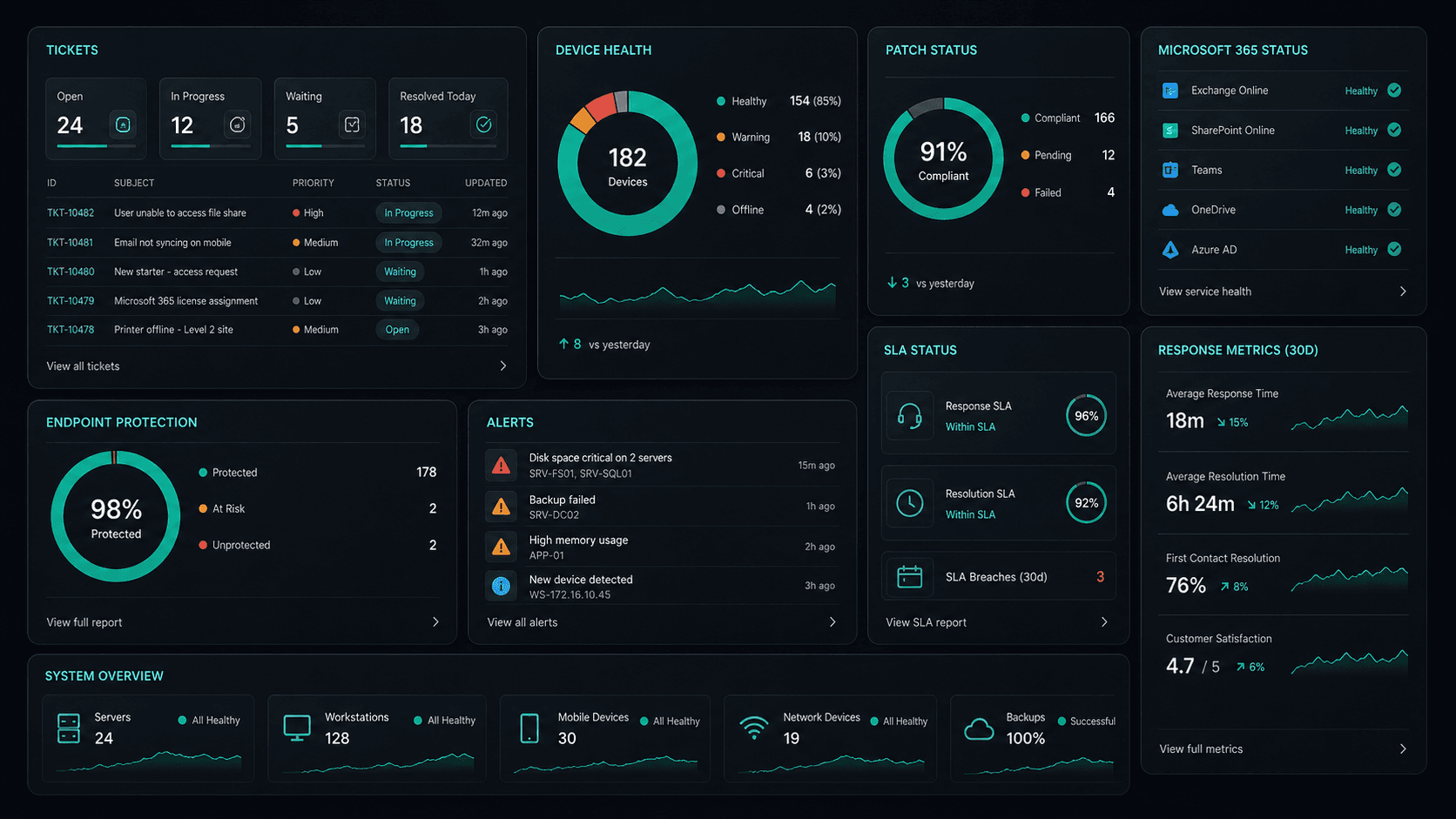
What's included
Cloud Solutions in Dee Why. One team.
Microsoft 365 Management
Full lifecycle management of Exchange, Teams, SharePoint, and OneDrive — deployment, security, and optimisation.
Azure Cloud Infrastructure
Design, deploy, and manage Azure environments tailored to your workloads — VMs, networking, and storage.
Zero-Downtime Migrations
Move from on-prem or legacy cloud to Microsoft 365 and Azure with zero disruption to your team.
Cloud Security & Compliance
Entra ID, conditional access, Defender, and MFA — enterprise security configured for your environment.
Service detail
Your entire cloud, one team
Licence management, user provisioning, Teams, SharePoint, Exchange, and Intune — your entire Microsoft ecosystem managed.
Virtual machines, storage, networking, and Azure AD — designed, deployed, and maintained to best-practice standards.
Lift-and-shift or full re-architect migrations from on-premise to Azure or Microsoft 365 — zero downtime, fully tested.
EC2, S3, RDS, Lambda, and CloudFront — multi-cloud architectures built for performance, cost, and compliance.
Defender for Cloud, conditional access, MFA, and Entra ID — enterprise security posture maintained across your cloud estate.
Automated cloud backup with point-in-time restore. DR runbooks tested annually — RTO and RPO targets met.
Monthly licence and resource reviews to eliminate waste — reserved instances, right-sizing, and savings plan recommendations.
Uptime, performance, and security alerts across your cloud — issues detected and actioned before they impact the business.
Why OnIT
Everything in one cloud service
One provider. One invoice. Microsoft 365, Azure, migrations, and security — all managed.
Full cloud visibility
Monitor licences, usage, and spend across your Microsoft cloud — with monthly reviews to optimise costs.
Microsoft cloud specialists
Microsoft 365, Azure, Exchange, Teams, SharePoint, Entra ID — your entire Microsoft ecosystem, fully managed.


Sydney-based cloud team
Local cloud engineers across Greater Sydney. On-site workshops, remote support, and 24/7 monitoring.
Cloud security baseline
Defender, MFA, conditional access, and Entra ID — enterprise security configured and maintained by our team.
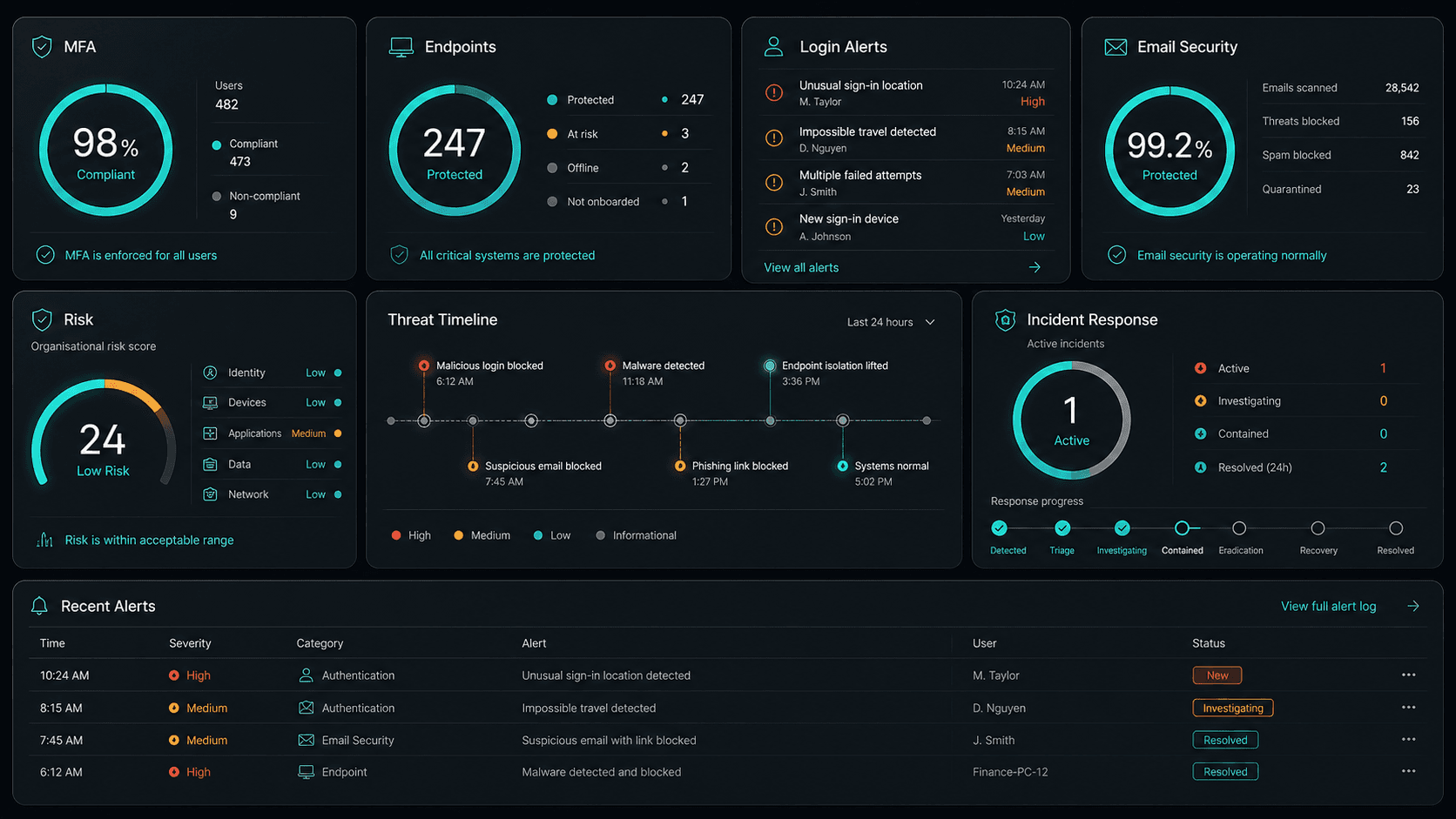




Technology Ecosystem
Powered by Enterprise Technology
A constellation of best-in-class platforms, deployed and managed as one seamless service.
Service Breakdown
What's inside your plan
Click any card to see exactly what's included in each service area.

Cloud Solutions that scales from 5 to 200 seats, across every Northern Beaches business.
Why OnIT Solutions
Your Dee Why business, without the overhead.
Serving Dee Why (2099) and the broader Northern Beaches area — our Sydney-based engineers understand the Northern Beaches business community and are reachable when you need them. Whether you're a 5-person team or a growing operation with 200 seats, we scale cloud solutions to fit.
By the numbers
Measurable outcomes, guaranteed in writing
No surprise invoices. No waiting on hold. No different technician every time you call.
At a Glance
Included in your plan
Got questions?
Frequently asked questions
Also serving nearby
Cloud Solutions across Northern Beaches
Explore further
Related services for Dee Why
Cybersecurity
Threat monitoring, Essential Eight compliance, and endpoint detection — keeping your business secure around the clock.
IT Support Sydney
On-demand helpdesk and on-site support for your team. Fast response, local engineers, no lock-in contracts.
AI Automation
Workflow automation, AI chatbots and voice agents that reduce admin and free your team to focus on growth.

Get started
Ready for better Cloud Solutions
in Dee Why?
Book a free cloud solutions assessment with one of our Sydney-based engineers serving Dee Why and Northern Beaches. No lock-in, no obligation.
No lock-in contracts · Sydney-based engineers · Same-day response