Cloud Solutions · Auburn
Cloud Solutions Auburn: Restore a Business Workflow
Recover the work your business needs to perform, as well as the files behind it. Map cloud dependencies and test a complete task before declaring a restore successful.
No lock-in · Sydney-based engineers · Response <4h

<4h
Response SLA
Priority response in Auburn
99.9%
Uptime Target
SLA-backed availability
0
Lock-In Contracts
Cancel anytime, no penalties
100%
Australian Team
Local engineers, no offshore
Technology partners and platforms we work with


What we deliver
Cloud Solutions that works while you do.
Everything your Auburn business needs — managed as one seamless service with a fixed monthly price and guaranteed response times.
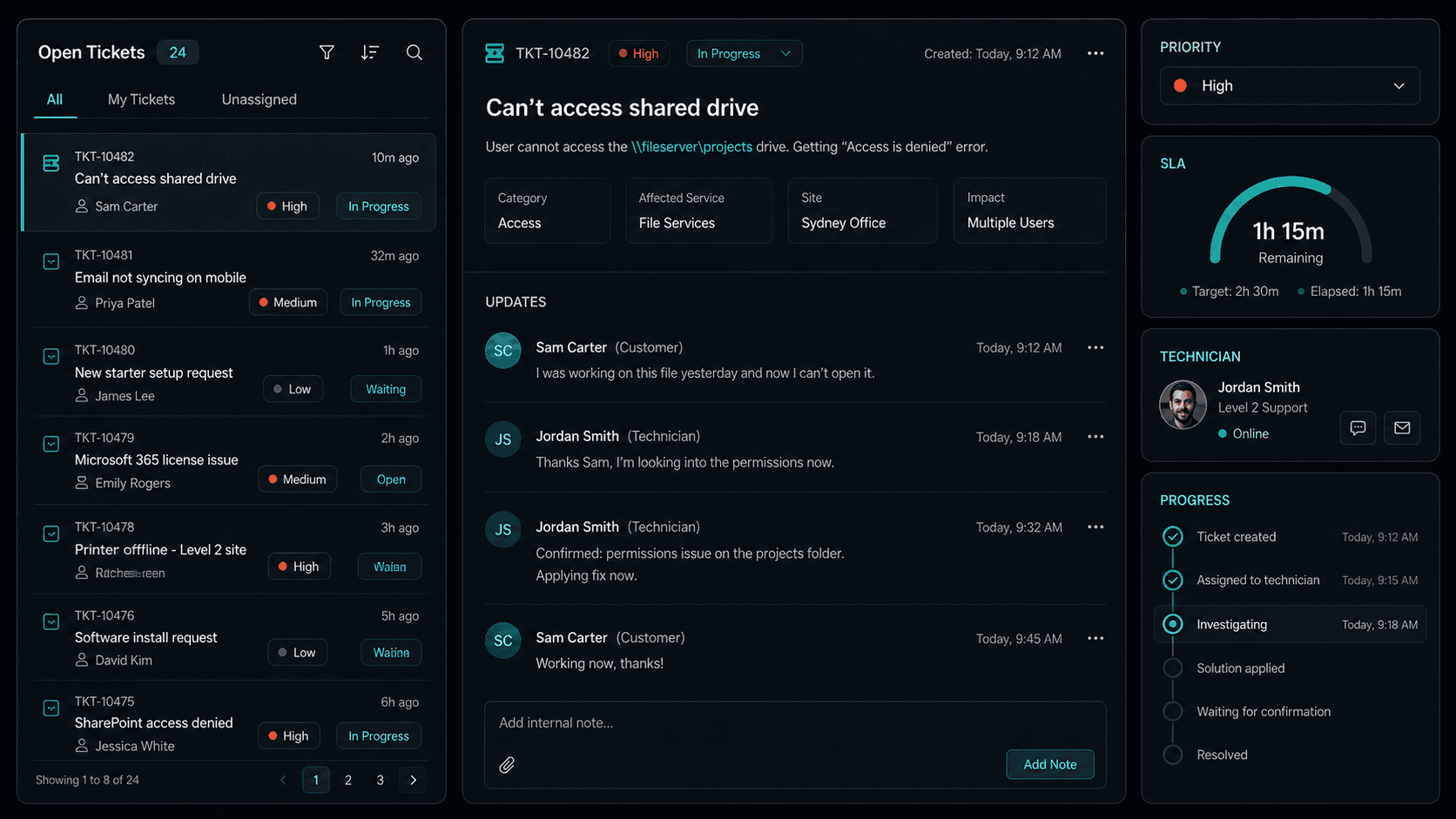
Last updated: 12 October 2026
Choose the business task that recovery must enable
Restoring data is valuable only when the business can use it. An Auburn team might need to reopen a customer record, retrieve its attachments and send an approved response through a connected application. Define that complete task before discussing recovery tools. OnIT's cloud and disaster recovery services provide a basis for assessing the technical parts, while your business owner explains what usable work looks like. The starting point is an observable outcome rather than a restored folder count.
Select a bounded workflow for the first exercise. State who performs it, what information starts the process and what result should be produced. Include the normal checks that make the result trustworthy. If several departments depend on the task, ask them to agree which part must return first. This prioritisation helps the recovery plan distinguish essential work from convenient features, especially where the organisation cannot restore every system at the same time.
Trace the dependencies behind a single transaction
Follow a representative item from arrival to completion. Identify the cloud application, identity, document location and any integration that transfers information between systems. Record supplier contacts and configuration records needed to rebuild the path. Include background jobs that staff do not normally open themselves. A recovered application can still be unusable if its sign-in route, file permissions or connection to another service remains broken. The map should expose those requirements before a real incident.
Ask where each dependency gets its information and whether the sources can be restored to compatible points. A current customer record paired with an older attachment store may need reconciliation. Document which system is authoritative when the copies disagree. The business owner should approve the reconciliation rule, because a technical operator may not know which record reflects a completed business decision. Keep uncertain relationships visible rather than simplifying the diagram until the important difficulty disappears.

Design the exercise so live work remains controlled
Agree the test data, destination and authorised participants. An isolated or otherwise controlled restoration may allow verification without replacing active records, depending on the platforms involved. Ask the provider which approach is supported and what permissions are required. Record any live connections that need to stay disabled during the exercise. Restored automation should not unexpectedly send customer messages or duplicate transactions simply because the application considers the recovered items ready for processing.
Define the stop conditions before beginning. Examples include a missing approval, an unexpected production connection or a discrepancy that the test owner cannot explain. Assign a person who can pause the exercise and keep a record of actions taken. Protect sensitive test material and limit access to the people who need it. A useful recovery rehearsal teaches the team how to make decisions under pressure while keeping the boundaries of the test clear to everyone involved.
Verify identities, relationships and outputs together
Have the nominated user sign in through the approved route and open the restored information. Check permissions from their role rather than an administrator account with broad access. Ask them to complete the defined task and inspect the resulting output. If the workflow uses an integration, confirm the expected handoff with an appropriate controlled example. Note every manual correction required, because a restore that depends on unrecorded expert intervention is harder to repeat during an actual disruption.
Compare the result with the acceptance definition agreed at the start. Record data gaps, unavailable attachments, incorrect references and any difference in the business outcome. Separate faults that prevent use from issues that can be managed temporarily. The exercise should not be described as complete merely because the restoration tool reports success. A clear result identifies which parts of the workflow were demonstrated, which remain untested and who will address the unresolved dependencies.

Turn the result into an operating recovery plan
Use the exercise to refine the recovery order and responsible contacts. Capture the steps that required business judgement as well as the technical actions. Record how people will request restoration when the usual communication platform is unavailable. Discuss the actual elapsed effort and remaining constraints without converting one rehearsal into a guaranteed incident timeline. The conditions of a live disruption may differ, and the plan should state where supplier availability or missing evidence could affect progress.
Keep the workflow owner responsible for changes to the business process. A new application, integration or document location can invalidate an earlier exercise even when the backup configuration has not changed. Set a review trigger for material changes and assign follow-up tests where needed. Include recovery documentation in an accessible business-controlled location, with appropriate protection. A plan that only the original project engineer can interpret leaves the business dependent on the availability of one person.
Prepare an Auburn recovery conversation
Bring one important workflow, its application list and a description of the last completed task the business would need to reconstruct. Use OnIT's cloud solutions service to identify platform dependencies and backup and disaster recovery to scope the exercise. Ask for the business acceptance criteria to be included in the proposal. This connects the protection investment to a visible operating requirement rather than a collection of separate technical features.
Your Auburn organisation should finish with evidence that an authorised user can perform the selected task using recovered information. Where that evidence is incomplete, retain the limitation and a named action owner. Extend testing to other workflows according to business priority instead of assuming one successful example covers everything. The lasting value is a recovery sequence that people can follow, challenge and maintain as the cloud environment changes, with clear responsibility for deciding when ordinary work can safely resume.
Quick Facts
“For Auburn businesses, cloud solutions isn't just about keeping things running — it's about building a technology foundation that drives growth across Western Sydney.”
— OnIT Solutions, Western Sydney
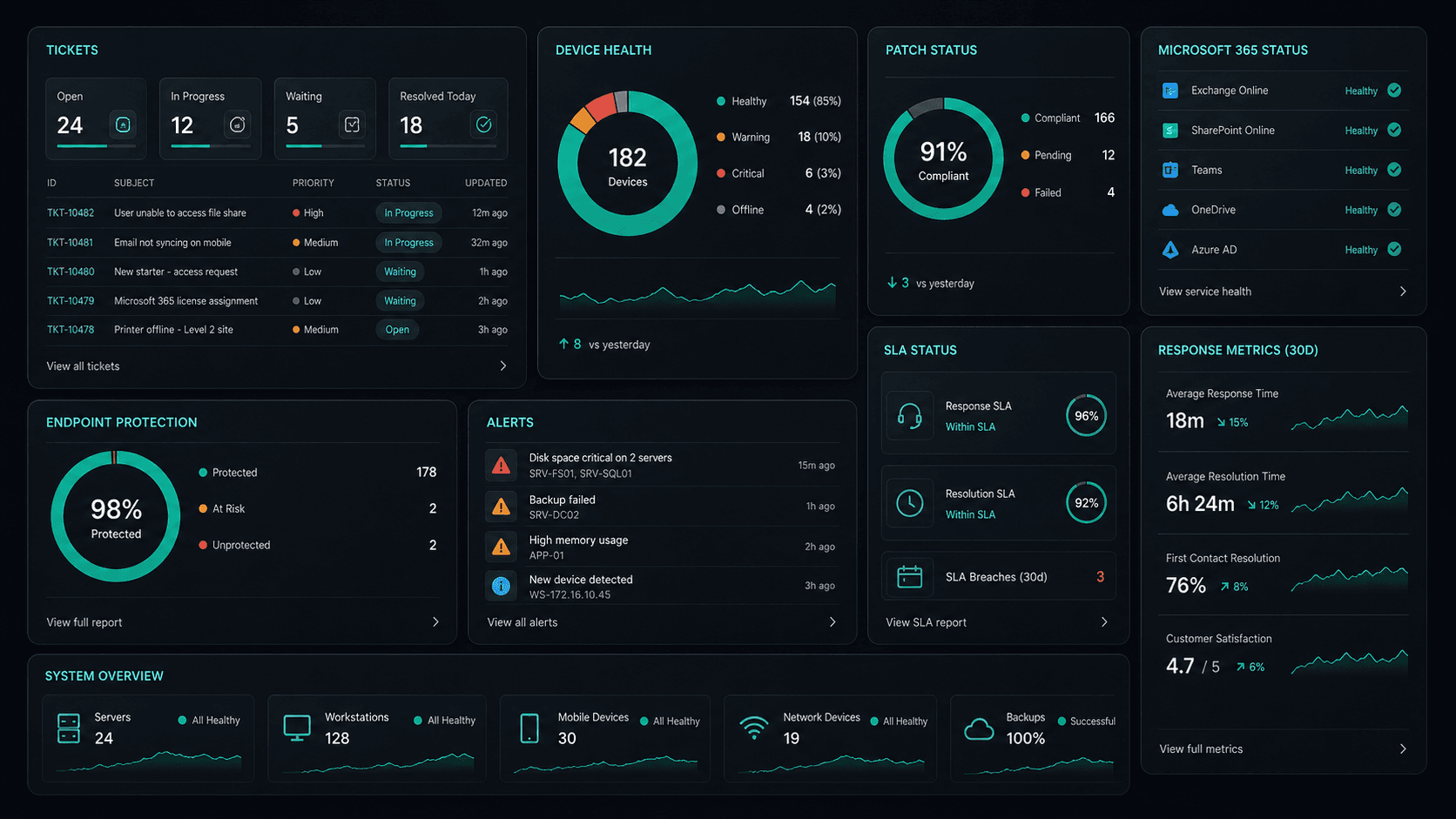
What's included
Cloud Solutions in Auburn. One team.
Microsoft 365 Management
Full lifecycle management of Exchange, Teams, SharePoint, and OneDrive — deployment, security, and optimisation.
Azure Cloud Infrastructure
Design, deploy, and manage Azure environments tailored to your workloads — VMs, networking, and storage.
Zero-Downtime Migrations
Move from on-prem or legacy cloud to Microsoft 365 and Azure with zero disruption to your team.
Cloud Security & Compliance
Entra ID, conditional access, Defender, and MFA — enterprise security configured for your environment.
Service detail
Your entire cloud, one team
Licence management, user provisioning, Teams, SharePoint, Exchange, and Intune — your entire Microsoft ecosystem managed.
Virtual machines, storage, networking, and Azure AD — designed, deployed, and maintained to best-practice standards.
Lift-and-shift or full re-architect migrations from on-premise to Azure or Microsoft 365 — zero downtime, fully tested.
EC2, S3, RDS, Lambda, and CloudFront — multi-cloud architectures built for performance, cost, and compliance.
Defender for Cloud, conditional access, MFA, and Entra ID — enterprise security posture maintained across your cloud estate.
Automated cloud backup with point-in-time restore. DR runbooks tested annually — RTO and RPO targets met.
Monthly licence and resource reviews to eliminate waste — reserved instances, right-sizing, and savings plan recommendations.
Uptime, performance, and security alerts across your cloud — issues detected and actioned before they impact the business.
Why OnIT
Everything in one cloud service
One provider. One invoice. Microsoft 365, Azure, migrations, and security — all managed.
Full cloud visibility
Monitor licences, usage, and spend across your Microsoft cloud — with monthly reviews to optimise costs.
Microsoft cloud specialists
Microsoft 365, Azure, Exchange, Teams, SharePoint, Entra ID — your entire Microsoft ecosystem, fully managed.


Sydney-based cloud team
Local cloud engineers across Greater Sydney. On-site workshops, remote support, and 24/7 monitoring.
Cloud security baseline
Defender, MFA, conditional access, and Entra ID — enterprise security configured and maintained by our team.
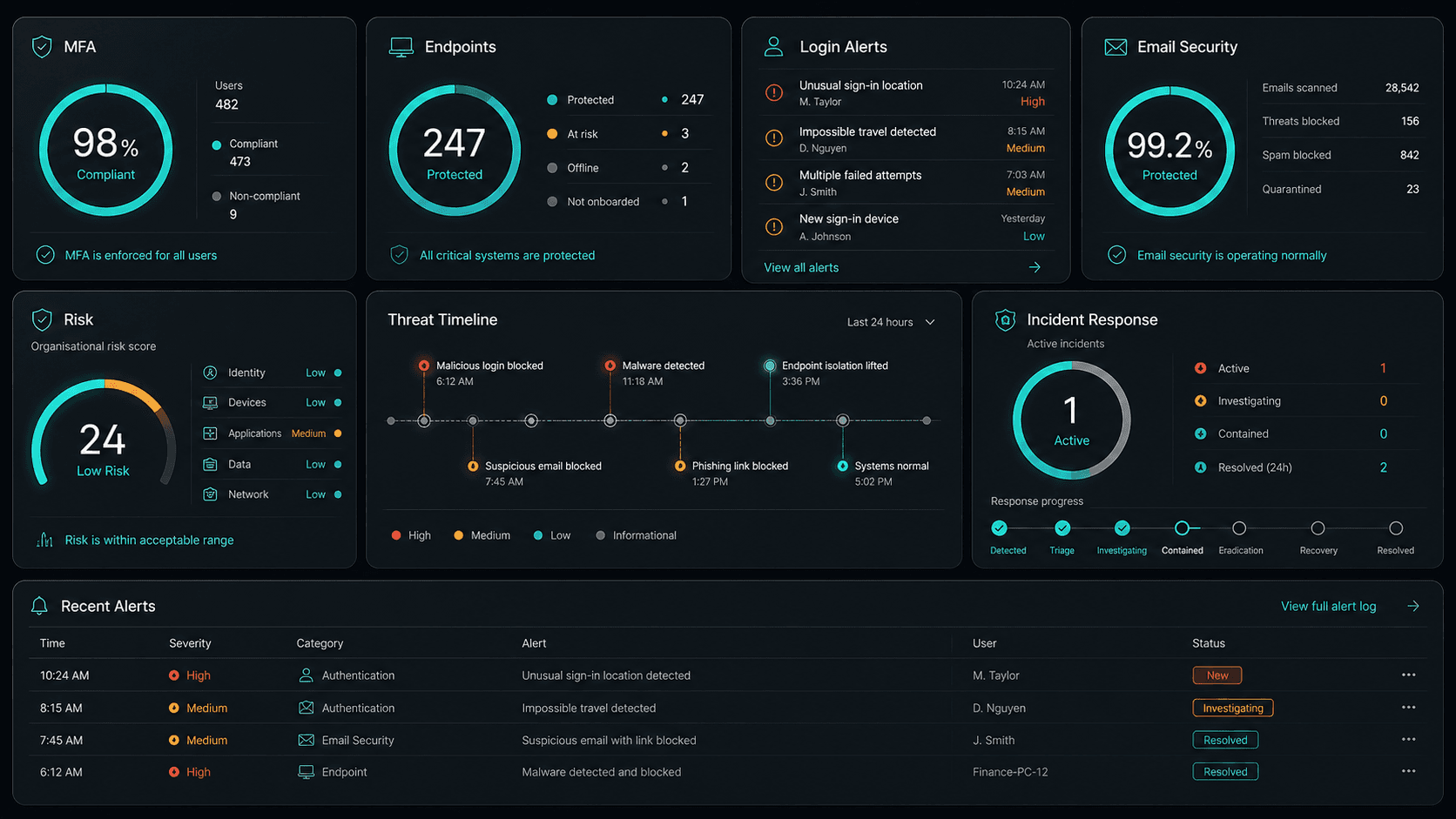




Technology Ecosystem
Powered by Enterprise Technology
A constellation of best-in-class platforms, deployed and managed as one seamless service.
Service Breakdown
What's inside your plan
Click any card to see exactly what's included in each service area.

Cloud Solutions that scales from 5 to 200 seats, across every Western Sydney business.
Why OnIT Solutions
Your Auburn business, without the overhead.
Serving Auburn (2144) and the broader Western Sydney area — our Sydney-based engineers understand the Western Sydney business community and are reachable when you need them. Whether you're a 5-person team or a growing operation with 200 seats, we scale cloud solutions to fit.
By the numbers
Measurable outcomes, guaranteed in writing
No surprise invoices. No waiting on hold. No different technician every time you call.
At a Glance
Included in your plan
Got questions?
Frequently asked questions
Also serving nearby
Cloud Solutions across Western Sydney
Explore further
Related services for Auburn
Cybersecurity
Threat monitoring, Essential Eight compliance, and endpoint detection — keeping your business secure around the clock.
IT Support Sydney
On-demand helpdesk and on-site support for your team. Fast response, local engineers, no lock-in contracts.
AI Automation
Workflow automation, AI chatbots and voice agents that reduce admin and free your team to focus on growth.

Get started
Ready for better Cloud Solutions
in Auburn?
Book a free cloud solutions assessment with one of our Sydney-based engineers serving Auburn and Western Sydney. No lock-in, no obligation.
No lock-in contracts · Sydney-based engineers · Same-day response