AI Agent Deployment · Lakemba
AI Agent Deployment Lakemba: Handle Tool Failures Honestly
An agent should distinguish an unsuccessful operation from an operation whose result is unknown. Build the recovery journey alongside the normal tool integration.
No lock-in · Sydney-based engineers · Response <4h

<4h
Response SLA
Priority response in Lakemba
99.9%
Uptime Target
SLA-backed availability
0
Lock-In Contracts
Cancel anytime, no penalties
100%
Australian Team
Local engineers, no offshore
Technology partners and platforms we work with







What we deliver
AI Agent Deployment that works while you do.
Everything your Lakemba business needs — managed as one seamless service with a fixed monthly price and guaranteed response times.
Last updated: 14 October 2026
Name the failure conditions behind a simple error message
A Lakemba business deploying an AI agent should ask what happens when a connected tool cannot complete its work. OnIT Solutions builds agents with CRM, calendar, helpdesk and API integrations, with testing and managed infrastructure options scoped to the project. Each connection introduces conditions that a conversational response alone cannot resolve. A request may be rejected before execution, a service may be unavailable or a response may be lost after an action occurred. Those situations need different treatment. Begin by describing them with the system owner rather than giving every failure the same generic message.
Create a tool inventory showing the operation, expected response and evidence of completion. Ask which failures the connected service can report clearly and which leave uncertainty. The business needs to know whether a failed conversation could still leave a changed record or an external message. Keep this discussion tied to the actual integration and supported behaviour. Do not promise that an agent can diagnose every provider fault from its text response. The useful outcome is an agreed operating distinction between completed, rejected, pending and unknown work.
Make the user-facing result match the known state
If a tool rejects an operation, the agent should explain the relevant next step without claiming that work has been completed. If the result is uncertain, avoid presenting either success or definite failure as a fact. Give the user a safe route to checking the status. That may mean a staff handover, a reference to the attempted request or an instruction to wait for confirmation. The right wording depends on the workflow, but it should not encourage repeated consequential actions simply to make the interface feel responsive.
Review messages with the staff responsible for supporting the process. A technically accurate error code may be unhelpful to a customer, while an overly reassuring sentence can hide the need for intervention. Separate what the user needs to know from internal diagnostic detail. Do not display credentials, private records or raw provider responses in a public conversation. Test the language using ordinary failure examples and ask reviewers what they believe happened. Their interpretation is part of acceptance because unclear wording can create duplicate work even when the underlying tool handling is correct.

Give staff enough context to investigate without excessive exposure
A handover should identify the attempted business action, the relevant record reference and the known result. Include useful timing and status information where available, while avoiding unnecessary copies of sensitive content. Staff should be able to distinguish a validation problem from an unavailable supplier before choosing the next step. Decide where that evidence is retained and who can access it. A failure report scattered across several personal inboxes is difficult to follow and may expose more information than the support task requires.
Assign an owner to unresolved attempts. A queue entry is not a completed handover until somebody is responsible for reviewing it. Establish how staff check the authoritative system before repeating an action whose result is unknown. Record the resolution so another person does not investigate the same request independently and create another operation. If the connected service cannot provide sufficient evidence, document the limitation and consider a narrower workflow. Human review is useful only when the reviewer has a practical way to establish what happened.
Test interruption at the points where state can change
Use controlled scenarios to observe failures before a tool call, during processing and after the external system has accepted work. Those points can produce different consequences even when the visible conversation ends similarly. Verify the system record and any outbound effect, not merely the agent's final text. Where the test environment cannot reproduce a condition, retain it as an unresolved test limitation. The deployment decision should reflect that uncertainty rather than quietly treating every untested provider behaviour as equivalent to a successful ordinary request.
Check whether failure in one tool leaves later steps enabled. A workflow should not continue using invented results from a failed dependency. For example, a missing record lookup should not become permission to create a replacement record automatically unless that behaviour is explicitly designed and accepted. Include an out-of-order response and a slow request where the selected systems permit testing. Record the expected handling of partial progress so future developers understand why the agent pauses or escalates instead of improvising a plausible completion.

Use recurring faults to improve the integration deliberately
Review failures by their operational effect and cause where evidence supports it. A high count of rejected fields may indicate a mapping problem, while repeated supplier outages may require an alternative operating procedure. Avoid changing the agent's instructions for every isolated error without checking the actual tool response. Track whether a proposed fix reduces the relevant failure and whether it introduces another problem. Keep examples for regression testing, with personal information removed where appropriate, so the same integration defect is less likely to return during later changes.
For Lakemba agent deployment, bring the connected-system owners and examples of work that would be costly or confusing to repeat. Discuss failure handling through OnIT's AI agent integration service. Ask the scope to identify completion evidence, user messages, staff ownership and unresolved provider limitations. Include recovery testing in acceptance rather than leaving it until the first live fault. This gives the business a truthful response when tools fail and a defined way to complete or close the affected work without claiming every external dependency will always be available.
Quick Facts
“For Lakemba businesses, ai agent deployment isn't just about keeping things running — it's about building a technology foundation that drives growth across South West Sydney.”
— OnIT Solutions, South West Sydney
What's included
AI Agent Deployment in Lakemba. One team.
Custom AI Agent Builds
Voice receptionists, helpdesk agents, and data processors — built to your workflows with full source code ownership.
Data Sovereignty & Local LLMs
Deploy on-premises with Ollama and open-source models — your data never leaves your infrastructure.
System Integration
Connect AI agents to your CRM, calendar, helpdesk, and APIs — fully embedded in your existing workflows.
Managed AI Infrastructure
We host, monitor, and maintain your AI agents — scaling capacity as your usage grows.
Service detail
Enterprise AI agents, your infrastructure
Voice receptionists, helpdesk agents, and sales assistants — built to your workflows with full source code ownership.
Claude, GPT-4, Mistral, and Llama — we deploy the right model for your performance, cost, and privacy requirements.
On-premise or private cloud deployment using Ollama or AWS Bedrock — your data never leaves your infrastructure.
Retrieval-augmented generation pipelines trained on your documents, FAQs, and internal knowledge — accurate, grounded responses.
Agents wired into Salesforce, HubSpot, ServiceNow, or custom APIs — automated actions, not just answers.
Vapi, Twilio, and telephony integrations — AI agents that answer calls, qualify leads, and book appointments.
Full audit trails, RBAC, and compliance documentation — meeting Australian data sovereignty and privacy requirements.
Production observability, hallucination monitoring, and continuous prompt tuning — agents that improve over time.
Why OnIT
Everything in one AI deployment service
One team. Full ownership. Custom AI agents built, deployed, and managed on your infrastructure.
Custom agent builds
Voice receptionists, helpdesk agents, data processors — built to your workflows with full source code ownership.
Any model, any platform
Claude, GPT-4, Ollama, AWS Bedrock — we deploy on the right platform for your data, budget, and compliance needs.









Sydney-based AI engineers
Local AI engineers who understand Australian compliance and data sovereignty requirements.
Data sovereignty built in
Local LLM deployment available — your data never leaves your infrastructure. Full audit trails and access controls.
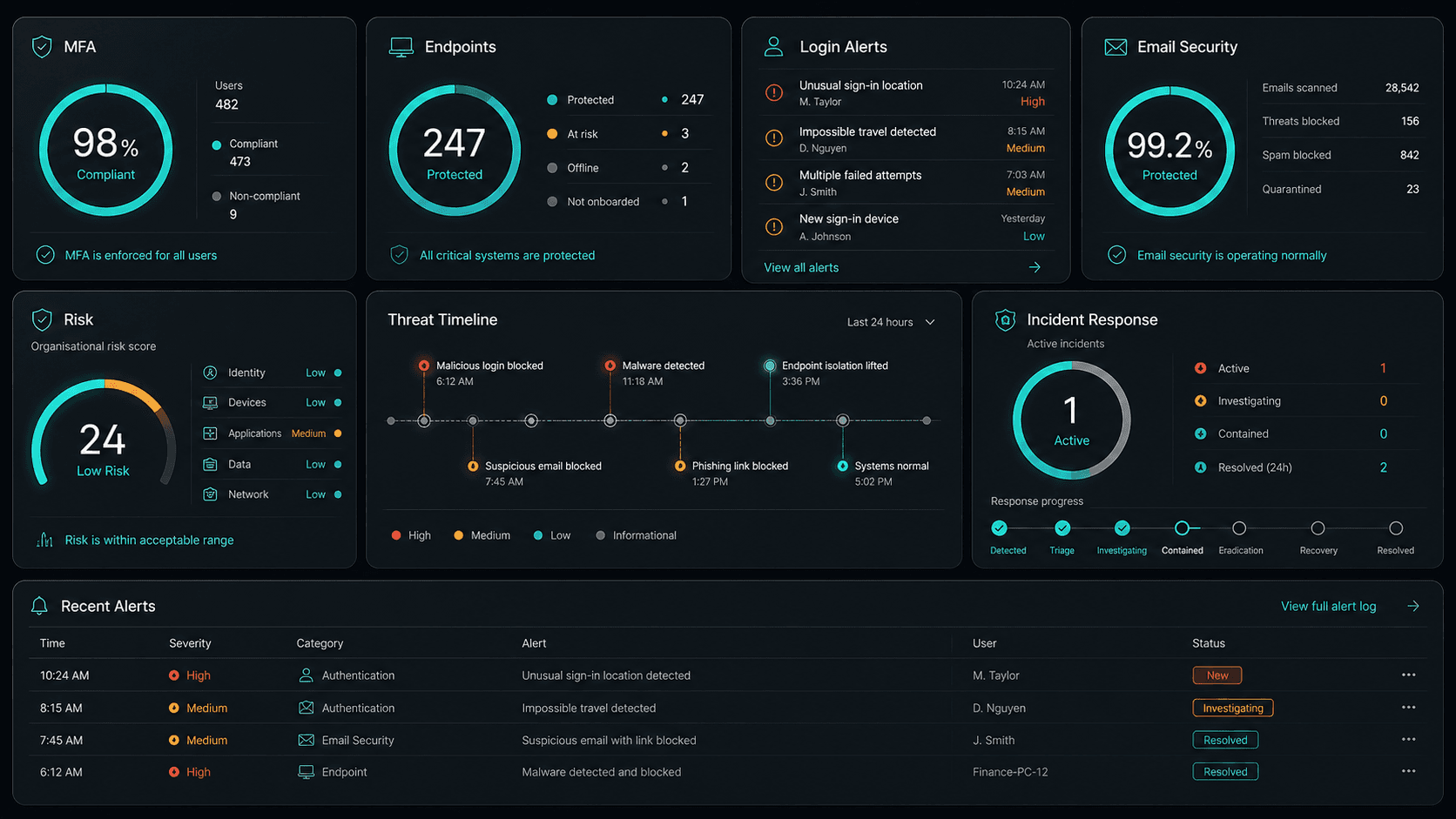











Technology Ecosystem
Powered by Enterprise Technology
A constellation of best-in-class platforms, deployed and managed as one seamless service.
Service Breakdown
What's inside your plan
Click any card to see exactly what's included in each service area.

AI Agent Deployment that scales from 5 to 200 seats, across every South West Sydney business.
Why OnIT Solutions
Your Lakemba business, without the overhead.
Serving Lakemba (2195) and the broader South West Sydney area — our Sydney-based engineers understand the South West Sydney business community and are reachable when you need them. Whether you're a 5-person team or a growing operation with 200 seats, we scale ai agent deployment to fit.
By the numbers
Measurable outcomes, guaranteed in writing
No surprise invoices. No waiting on hold. No different technician every time you call.
At a Glance
Included in your plan
Got questions?
Frequently asked questions
Also serving nearby
AI Agent Deployment across South West Sydney
Explore further
Related services for Lakemba
Cybersecurity
Threat monitoring, Essential Eight compliance, and endpoint detection — keeping your business secure around the clock.
IT Support Sydney
On-demand helpdesk and on-site support for your team. Fast response, local engineers, no lock-in contracts.
AI Automation
Workflow automation, AI chatbots and voice agents that reduce admin and free your team to focus on growth.

Get started
Ready for better AI Agent Deployment
in Lakemba?
Book a free ai agent deployment assessment with one of our Sydney-based engineers serving Lakemba and South West Sydney. No lock-in, no obligation.
No lock-in contracts · Sydney-based engineers · Same-day response