AI Agent Deployment · Double Bay
AI Agent Deployment Double Bay: Classify Tickets Without Losing Context
A category is useful when it helps the right team take the next action. Define ticket labels and review uncertain cases before automating routing decisions.
No lock-in · Sydney-based engineers · Response <4h

<4h
Response SLA
Priority response in Double Bay
99.9%
Uptime Target
SLA-backed availability
0
Lock-In Contracts
Cancel anytime, no penalties
100%
Australian Team
Local engineers, no offshore
Technology partners and platforms we work with







What we deliver
AI Agent Deployment that works while you do.
Everything your Double Bay business needs — managed as one seamless service with a fixed monthly price and guaranteed response times.
Last updated: 14 October 2026
Define the operating purpose of a ticket category
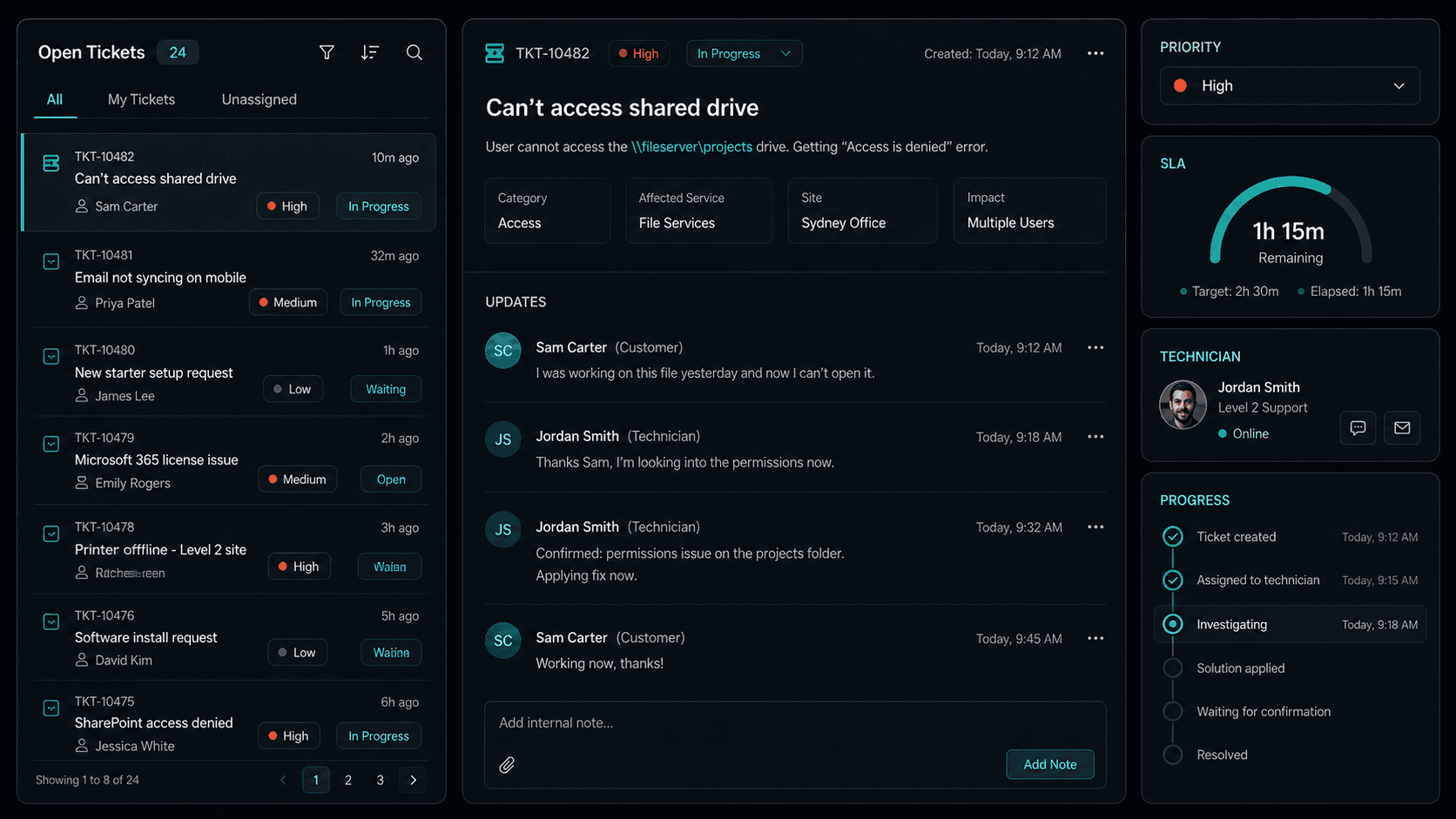
A Double Bay business deploying a helpdesk agent should decide what ticket classification is meant to improve. OnIT Solutions builds custom helpdesk agents and connects them to business systems under an agreed scope. Labels may support assignment, reporting or a particular review process, but those purposes are not identical. Begin with the action a category enables and the team responsible for it. Avoid a large taxonomy copied from another organisation when staff cannot explain how the distinctions affect their own work.
Review existing requests with the helpdesk team. Identify categories that are consistently understood and those used as catch-all labels. If two teams classify the same issue differently, resolve the operating rule before asking an agent to reproduce it. Keep the number of meaningful choices proportionate to the workflow. A more detailed taxonomy is not automatically a better one. The project needs agreed examples and ownership so acceptance can assess whether classification supports the process rather than simply fills a required field.
Separate topic, urgency and routing authority
A request's subject does not necessarily establish its urgency. A familiar technical problem may affect one person or halt an essential activity, while urgent wording may lack evidence of wider impact. Define what information supports priority and which decisions remain with staff. Keep category, severity and assignment as separate concepts where the selected system permits. The agent should not escalate every strongly phrased message or downgrade a request merely because its topic usually appears in routine work.
Clarify whether the agent proposes a label or applies it automatically. Those modes need different permissions and review arrangements. A first deployment may prepare suggestions for staff to check, while later routing requires evidence that the rule works across important cases. Do not interpret successful tagging as permission to close tickets or make service commitments. The authorised actions should be explicit in the integration and tested alongside the classification output, particularly when category changes trigger other automation in the helpdesk system.

Preserve uncertainty and the original request
Some requests describe several issues or provide too little information for a reliable category. Define whether the agent asks for clarification, uses a review state or assigns a provisional label. Avoid forcing every request into one confident answer just because the destination field is mandatory. Keep the original context available to authorised staff and explain the reason for uncertainty. A summary should retain important impact details and distinguish what the user reported from what has been verified by a system check.
Test overlapping topics, ambiguous language and messages that change subject midway through the request. The agent may need to identify more than one task or preserve a single request for review, depending on the approved process. Do not split tickets automatically without deciding how ownership and customer communication will work. Staff should be able to correct a suggestion without losing history. The classification design must support the receiving team's judgement rather than replace ambiguity with labels that make reporting look tidy but hide unresolved work.
Check what labels actually trigger in the helpdesk
Inspect existing rules before writing categories into a live system. A field may send notifications, assign a team, start a response workflow or affect reporting. The integration brief should identify these consequences and confirm which are intended. A test that checks only the label text can miss an incorrect downstream action. Use a controlled environment or authorised records to observe the full result. Where the provider's configuration is managed elsewhere, involve its owner and document the boundary between agent behaviour and helpdesk automation.
Include staff overrides and reassignment in acceptance. If a person corrects a category, the agent should not repeatedly restore its earlier suggestion unless that behaviour is explicitly required. Record why corrections occur where useful, without making extra reporting burdensome. A correction may reveal unclear source information, an outdated category or a model error. Those causes need different responses. Keep the taxonomy and operating rules under named ownership so later changes do not silently invalidate the examples used to accept the initial deployment.

Evaluate routing quality through reviewed outcomes
Use a prepared set of actual request patterns with staff-approved expected handling. Assess whether tickets reach the appropriate owner and whether uncertainty is represented correctly. Overall accuracy alone can hide important mistakes in a smaller consequential category, so review the effect of errors as well as their count. Include unsupported and unusual requests. After launch, compare a representative sample of suggestions and overrides, with definitions consistent enough to understand changes. Do not claim that increasing automatic assignment is always an improvement if it shifts avoidable correction work to staff.
For Double Bay agent planning, bring the helpdesk owner, existing categories and anonymised examples of difficult requests. OnIT's custom helpdesk agent service can scope classification and integration around those rules. Ask for tests of downstream effects, staff overrides and ambiguous cases. Confirm who maintains the taxonomy and accepts changes. The result should help staff recognise and own work more consistently, while retaining the context and authority needed for judgement, rather than use automated labels as a substitute for understanding the request.
Quick Facts
“For Double Bay businesses, ai agent deployment isn't just about keeping things running — it's about building a technology foundation that drives growth across Eastern Suburbs.”
— OnIT Solutions, Eastern Suburbs
What's included
AI Agent Deployment in Double Bay. One team.
Custom AI Agent Builds
Voice receptionists, helpdesk agents, and data processors — built to your workflows with full source code ownership.
Data Sovereignty & Local LLMs
Deploy on-premises with Ollama and open-source models — your data never leaves your infrastructure.
System Integration
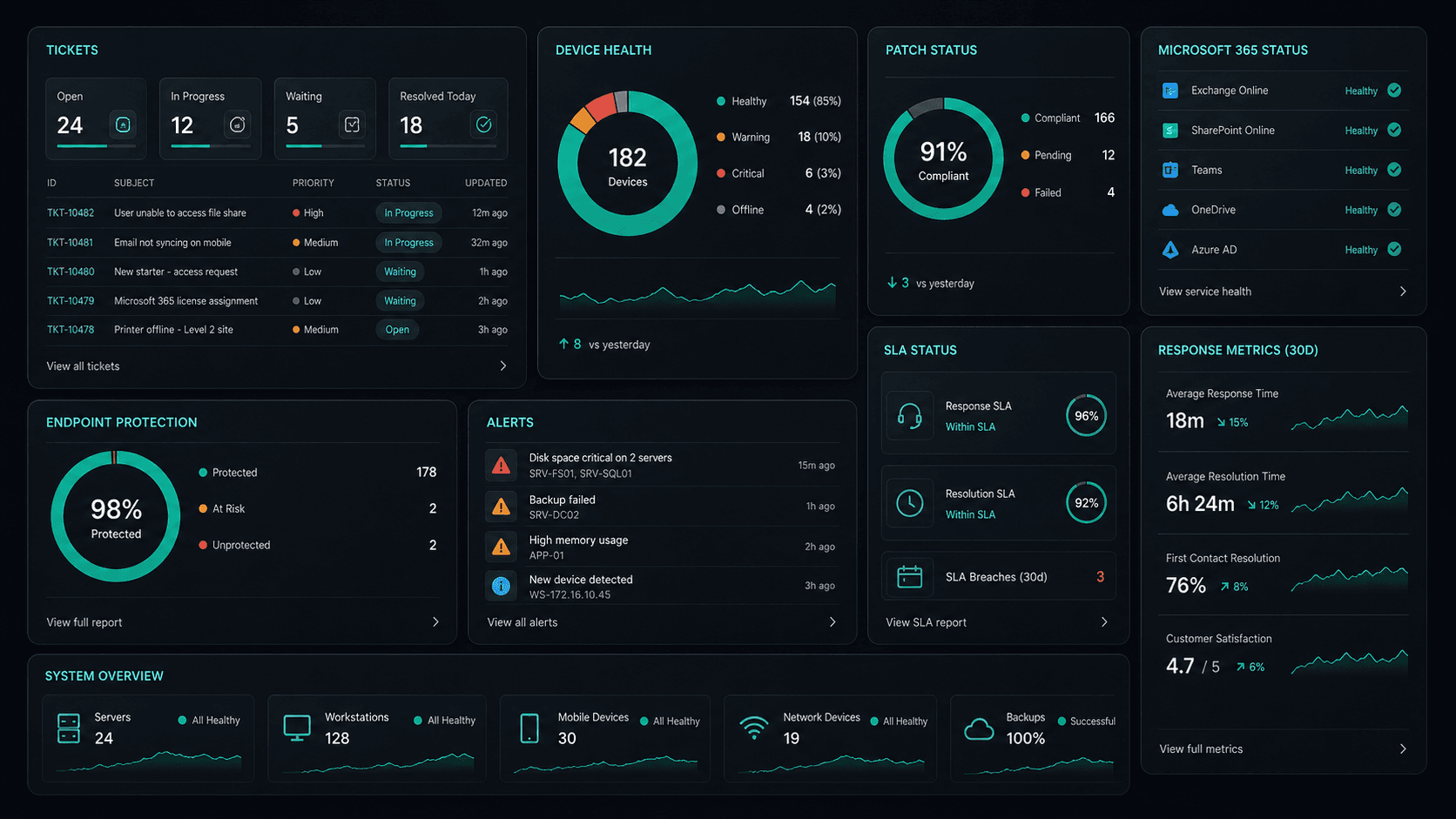
Connect AI agents to your CRM, calendar, helpdesk, and APIs — fully embedded in your existing workflows.
Managed AI Infrastructure
We host, monitor, and maintain your AI agents — scaling capacity as your usage grows.
Service detail
Enterprise AI agents, your infrastructure
Voice receptionists, helpdesk agents, and sales assistants — built to your workflows with full source code ownership.
Claude, GPT-4, Mistral, and Llama — we deploy the right model for your performance, cost, and privacy requirements.
On-premise or private cloud deployment using Ollama or AWS Bedrock — your data never leaves your infrastructure.
Retrieval-augmented generation pipelines trained on your documents, FAQs, and internal knowledge — accurate, grounded responses.
Agents wired into Salesforce, HubSpot, ServiceNow, or custom APIs — automated actions, not just answers.
Vapi, Twilio, and telephony integrations — AI agents that answer calls, qualify leads, and book appointments.
Full audit trails, RBAC, and compliance documentation — meeting Australian data sovereignty and privacy requirements.
Production observability, hallucination monitoring, and continuous prompt tuning — agents that improve over time.
Why OnIT
Everything in one AI deployment service
One team. Full ownership. Custom AI agents built, deployed, and managed on your infrastructure.
Custom agent builds
Voice receptionists, helpdesk agents, data processors — built to your workflows with full source code ownership.
Any model, any platform
Claude, GPT-4, Ollama, AWS Bedrock — we deploy on the right platform for your data, budget, and compliance needs.









Sydney-based AI engineers
Local AI engineers who understand Australian compliance and data sovereignty requirements.
Data sovereignty built in
Local LLM deployment available — your data never leaves your infrastructure. Full audit trails and access controls.











Technology Ecosystem
Powered by Enterprise Technology
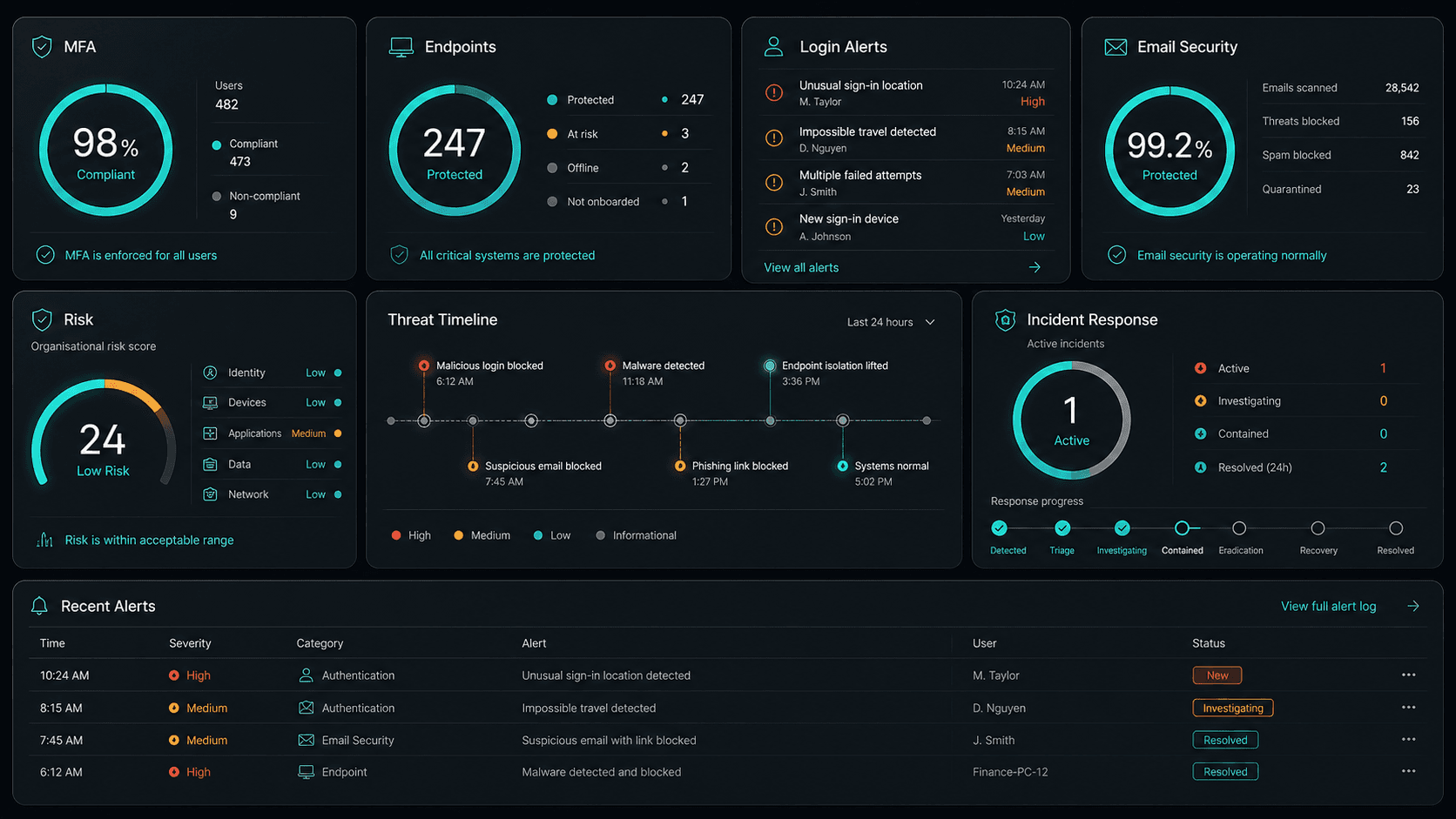
A constellation of best-in-class platforms, deployed and managed as one seamless service.
Service Breakdown
What's inside your plan
Click any card to see exactly what's included in each service area.

AI Agent Deployment that scales from 5 to 200 seats, across every Eastern Suburbs business.
Why OnIT Solutions
Your Double Bay business, without the overhead.
Serving Double Bay (2028) and the broader Eastern Suburbs area — our Sydney-based engineers understand the Eastern Suburbs business community and are reachable when you need them. Whether you're a 5-person team or a growing operation with 200 seats, we scale ai agent deployment to fit.
By the numbers
Measurable outcomes, guaranteed in writing
No surprise invoices. No waiting on hold. No different technician every time you call.
At a Glance
Included in your plan
Got questions?
Frequently asked questions
Also serving nearby
AI Agent Deployment across Eastern Suburbs
Explore further
Related services for Double Bay
Cybersecurity
Threat monitoring, Essential Eight compliance, and endpoint detection — keeping your business secure around the clock.
IT Support Sydney
On-demand helpdesk and on-site support for your team. Fast response, local engineers, no lock-in contracts.
AI Automation
Workflow automation, AI chatbots and voice agents that reduce admin and free your team to focus on growth.

Get started
Ready for better AI Agent Deployment
in Double Bay?
Book a free ai agent deployment assessment with one of our Sydney-based engineers serving Double Bay and Eastern Suburbs. No lock-in, no obligation.
No lock-in contracts · Sydney-based engineers · Same-day response