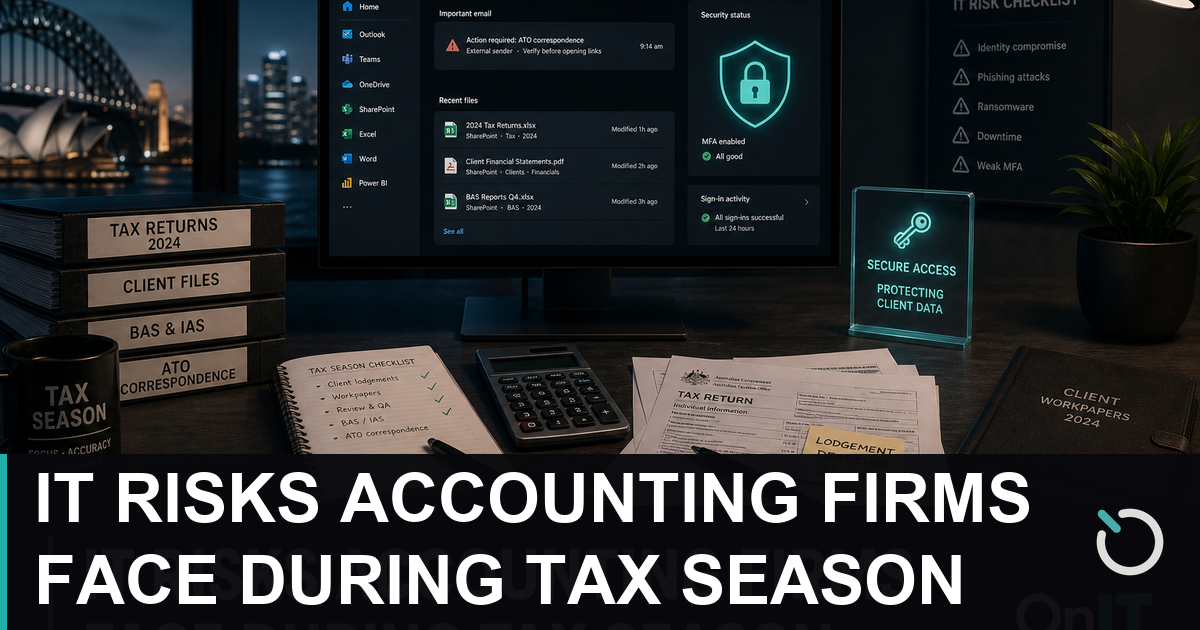
Tax season puts pressure on every accounting firm, but the operational strain does not stop at deadlines, client queries, and compliance work. It also creates a sharper and more expensive technology risk profile. During peak lodgement periods, firms handle larger volumes of tax file numbers, bank details, payroll records, identity documents, and financial statements. At the same time, staff are working faster, temporary workers may need access, and clients are sending urgent emails and files across multiple systems. That combination makes IT risks accounting firms face during tax season a serious business issue for Australian practices and the small to medium businesses that rely on them.
For Australian SMB owners and IT managers, this matters for two reasons. First, a security incident at your accounting firm can quickly become your incident too, especially if payroll, BAS, tax records, or cash-flow data are affected. Second, even without a breach, poor access controls, slow support, and failed backups can disrupt the busiest period of the year. This article looks at why tax season attracts cybercriminals, the most common operational and cybersecurity weak points, and the practical controls firms can put in place before the pressure peaks.
Why tax season increases IT risks for accounting firms
The biggest reason tax season is risky is simple: accountants are processing high-value information under time pressure. According to Practice Protect, accounting firms can face around 900 cyberattack attempts per week during tax season, with activity rising sharply compared with quieter periods. IRIS also points to a major spike in attacks as threat actors exploit high workloads, tighter deadlines, and lapses in vigilance.
From an attacker’s perspective, accounting practices are attractive because they hold complete identity and financial profiles. A compromised inbox or document system can expose tax file numbers, trust account information, payment details, and signed forms. That data can be sold, used for identity fraud, or leveraged in business email compromise. In practical terms, a criminal does not need to penetrate every system in a firm. One stolen Microsoft 365 login or one fake file-sharing email may be enough to gain access to years of client records.
Pressure changes behaviour
Workload changes how people work. Staff may skim emails instead of checking them properly, approve access for seasonal contractors too quickly, or postpone software updates because they fear downtime. Clients also behave differently during tax season. They are more likely to send urgent requests, attach sensitive files, and respond quickly to messages that appear to come from their accountant. That makes phishing and spoofing far more believable.
Consider a suburban accounting firm supporting 250 business clients across payroll, bookkeeping, and annual returns. In March and June, its team starts earlier, finishes later, and relies more heavily on email to chase missing records. If an attacker impersonates a partner asking a junior staff member to review a shared folder, the rushed context increases the chance of a mistake. This is why the IT risks accounting firms face during tax season are not just technical problems. They are operational risks amplified by human pressure.
Cybersecurity threats that peak during tax season
The most visible of the IT risks accounting firms face during tax season are cybersecurity threats. Phishing remains the leading issue because it scales well for attackers and works especially well when teams are busy. Firms may receive fake ATO notices, fraudulent client messages, counterfeit file-sharing links, and invoice scams timed to match real workflows. Verito describes a realistic scenario where one employee clicking a fake tax-related link can trigger serious downtime and client disclosure issues.
Phishing, spoofing, and credential theft
Credential theft is often the first stage. Once attackers gain access to email or cloud platforms, they can monitor conversations, intercept payment requests, and send convincing follow-up messages from inside the environment. LG Networks notes that stolen credentials are involved in a large share of breaches, which is why strong passwords, password managers, and multi-factor authentication matter so much.
For accounting firms, the impact is immediate. A compromised mailbox can expose draft returns, ASIC records, engagement letters, and scanned identification documents. A compromised cloud storage account can expose folders shared with dozens of business clients. In the Australian context, that may also trigger privacy obligations, client reporting requirements, and a significant reputational hit in a referral-driven market.
Ransomware and business interruption
Ransomware is particularly dangerous because it combines data loss with operational shutdown. Attackers know firms are less able to tolerate downtime near filing deadlines. If document management, practice management, or tax software becomes inaccessible for even one day, the backlog can become unmanageable. Diamond IT highlights that backups are essential, but backup success alone is not enough. Restore testing is what proves whether recovery will actually work under pressure.
Email authentication is another gap that often gets ignored until it matters. DMARC, SPF, and DKIM are not glamorous projects, but LG Networks points out they help reduce spoofing and domain impersonation. For firms discussing broader risk reduction, dedicated cybersecurity services can also help validate identity controls, endpoint protection, and monitoring before the busiest months arrive.
Staff fatigue, seasonal access, and support bottlenecks
Not every tax-season technology problem begins with a malicious attack. Many start with access friction, inconsistent onboarding, and support delays. Diamond IT identifies common issues such as contractor access, file-sharing difficulties, and slow support response. During tax season, those issues can quickly cascade from mild inconvenience into security exposure.
Temporary staff increase complexity
Seasonal staff can be necessary, but they raise the risk level if onboarding is rushed. New starters may be given broad permissions because it is faster than defining role-based access. Old accounts may remain active after contractors finish. Shared credentials may be used for convenience. Practice Protect reports that many firms see staff security training as a major challenge during peak periods, especially when temporary workers are added to the mix.
A practical example is a firm that brings in two short-term bookkeepers to help reconcile client accounts. If those workers receive blanket access to shared drives, historical tax records, and mailbox folders unrelated to their tasks, the blast radius of one mistake becomes much larger. Least-privilege access is slower to set up initially, but it sharply reduces exposure if an account is phished or a laptop is lost.
Fatigue leads to small but costly mistakes
Fatigue changes judgment. An employee who would normally verify a request by phone may skip that step after a long day. A manager may delay patching a device because rebooting it feels too disruptive. A partner may keep approving exceptions because clients are waiting. These are exactly the conditions attackers look for.
Support readiness also matters. If staff cannot get fast help with VPN issues, suspicious emails, printer failures, or password resets, they create workarounds. They forward files to personal inboxes, use unsecured messaging, or store documents locally until they can upload them later. Those shortcuts create shadow IT and make incident response harder. For firms with remote or hybrid workers, a clearly documented onboarding and offboarding checklist, rapid help desk coverage, and standardised device management are some of the fastest risk-reduction measures available.
Client data handling and secure workflow gaps
Another of the central IT risks accounting firms face during tax season is the way sensitive information moves through the business. In many firms, the real vulnerability is not a sophisticated exploit. It is an insecure workflow that became normal over time. Clients email identity documents, staff save them locally, then someone forwards a version to another team member, and finally a copy ends up in a shared folder with broad permissions.
LG Networks recommends secure client portals instead of email attachments for sensitive document exchange. That advice is practical because portals reduce both phishing exposure and accidental leakage. They also centralise audit trails, access control, and versioning. For Australian firms working with payroll reports, trust data, director IDs, and tax records, that traceability matters.
Remote work expands the attack surface
Remote and hybrid work add another layer. Diamond IT notes that outsourced and work-from-home arrangements are common in accounting, especially during busy periods. Home networks, unmanaged devices, weak Wi-Fi settings, and poorly configured remote access can all increase risk. A staff member working from a personal laptop on public Wi-Fi may not think they are creating a major issue, but if that device lacks patching, endpoint protection, or full-disk encryption, the firm is accepting unnecessary exposure.
Secure workflow design should include MFA on all cloud platforms, business-managed devices for anyone accessing core systems, restricted download permissions where possible, and documented rules for file sharing. It should also include clear retention and deletion processes. Tax season often creates a pile-up of downloaded spreadsheets, scanned forms, and duplicated client files. Without disciplined cleanup, sensitive data remains scattered across endpoints long after the lodgement work is done.
Where resilience planning is weak, document loss or encryption can be just as damaging as unauthorised access. This is why firms should review their backup and disaster recovery arrangements in the context of tax-season operations, not just general compliance. Recovery objectives need to reflect how much interruption the practice can actually tolerate in peak periods.
How accounting firms can reduce tax-season IT risk
The good news is that most of the IT risks accounting firms face during tax season can be reduced with disciplined, practical controls rather than large-scale transformation projects. The key is to prepare before workload peaks. Verito frames this well by focusing on identifying simple but critical gaps first, including weak email security, old devices, misconfigurations, and inconsistent access controls.
Start with the highest-impact controls
First, enforce multi-factor authentication across email, cloud storage, remote access, and any practice management platform. Second, review access rights before seasonal staff arrive, not after. Third, run short, scenario-based awareness training covering fake ATO messages, payment-change scams, voice phishing, and AI-generated impersonation attempts. LG Networks notes that regular awareness training can materially reduce phishing click rates, which makes it one of the most cost-effective controls available.
Next, test backups and restore procedures. A backup that has not been restored in a realistic test should not be treated as proven protection. Prioritise systems that would cause the most pain if unavailable for even half a day: tax software, document stores, email, and line-of-business databases. Document recovery time objectives clearly so leadership understands what the business can and cannot recover quickly.
Build an operational response plan
Firms should also define who does what when something goes wrong. If a staff member clicks a malicious link, do they know who to call immediately? If a partner’s mailbox is compromised, who disables access, checks forwarding rules, and notifies affected clients? If a server fails the week before a major deadline, what is the fallback workflow?
The final step is to align technology support with business reality. Tax season is not the time to discover that patching, monitoring, remote support, and endpoint visibility are inconsistent. Whether support is internal or outsourced, response coverage should match the pressure period. For Australian accounting firms, practical preparedness is what separates a manageable disruption from a client trust crisis.
Ultimately, the firms that cope best are not necessarily the ones with the largest IT budgets. They are the ones that remove preventable friction, reduce unnecessary access, secure client communications, and rehearse recovery before the pressure hits.
Conclusion
The main IT risks accounting firms face during tax season are well understood: phishing, credential theft, ransomware, rushed onboarding, weak file-sharing practices, support bottlenecks, and untested recovery plans. What makes them dangerous is timing. When deadlines are close and workloads are high, even a small lapse can affect client data, staff productivity, and the firm’s reputation.
For Australian SMBs and IT managers, the practical takeaway is clear. Review access before the rush, tighten email and identity controls, move sensitive exchanges into secure workflows, and prove that backups can be restored under pressure. Training should be short, relevant, and repeated. Support should be fast enough to prevent risky workarounds. And recovery plans should reflect the commercial reality of tax season, not ideal conditions on paper.
For firms that want to strengthen resilience without overcomplicating operations, a focused review of tax-season security controls, endpoint coverage, and recovery readiness is a sensible next step. The goal is not perfection. It is making sure the busiest time of year does not also become the most vulnerable.