Restructuring the OpenAI Microsoft Partnership for a Multi-Cloud Future
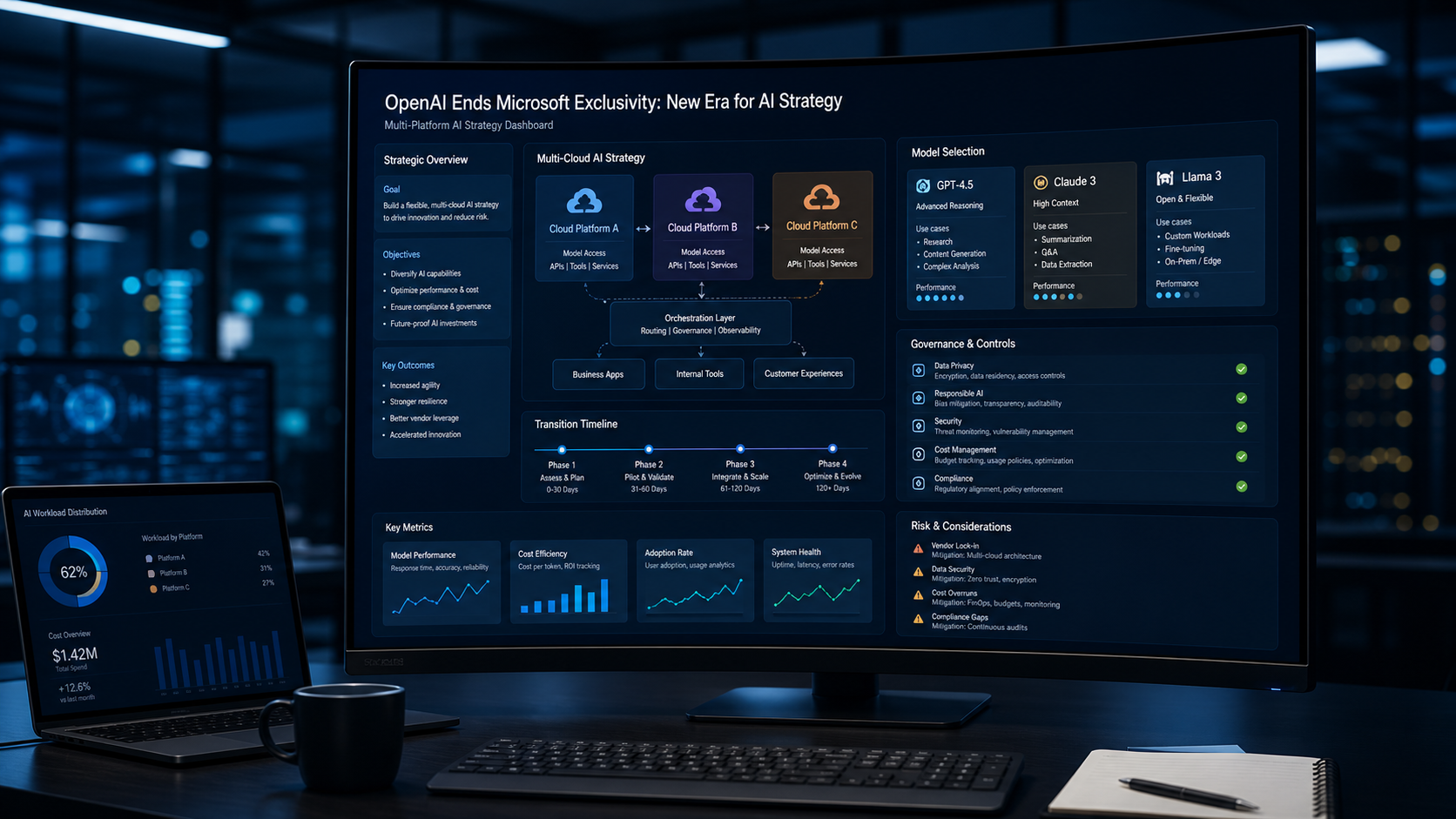
OpenAI is now free to serve its generative AI models across any cloud platform, marking a seismic shift in a relationship that has defined the industry's landscape for years. This change effectively ends Microsoft's status as the exclusive provider of computing power for the AI startup. The restructured OpenAI Microsoft partnership allows the creator of ChatGPT to deploy its technology on infrastructure provided by competitors like Amazon or SoftBank. This evolution provides OpenAI with the operational independence necessary to scale globally while maintaining its deep ties to the Microsoft ecosystem.
Securing Long-Term Access with Generative AI Licensing
While the exclusivity has dissolved, Microsoft has secured a non-exclusive license to OpenAI’s intellectual property and models through 2032. This agreement ensures that Microsoft can continue integrating cutting-edge technology into its own products, such as Copilot and various Azure AI services. For Australian business owners, this means that the core tools they currently rely on will remain stable and supported for the next decade. This generative AI licensing framework protects Microsoft's massive investment while allowing OpenAI to seek new growth avenues.
Diversifying Cloud Infrastructure for Global Scaling
Although Microsoft Azure remains the primary cloud partner for OpenAI, the ability to utilize diverse cloud infrastructure is a significant turning point. OpenAI can now leverage the specialized capabilities of other providers to meet the surging demand for its AI models. Australian IT managers should view this as an opportunity for increased flexibility in how they consume AI services within their existing cloud solutions frameworks. This shift encourages a more competitive market, potentially leading to better service levels and innovation across the board.
The updated agreement also simplifies the legal complexities surrounding the development of artificial general intelligence (AGI). Previously, the partnership included language that could have triggered major changes if OpenAI reached specific milestones in AGI development. By removing these constraints, both companies can focus on immediate engineering and research goals without the looming threat of contractual disruption. This clarity is essential for organisations developing a long-term AI strategy that requires predictable vendor relationships.
Microsoft's financial interest remains significant, with its stake in the company valued at over $135 billion according to the New York Times. The tech giant will continue to receive revenue-sharing payments through 2030, even as OpenAI builds new partnerships elsewhere. This transition allows both entities to mature independently while remaining "close allies" in the race to define the next generation of computing. The focus now shifts toward how these two giants will manage their shared interests alongside their individual financial goals.
Financial Stakes and the Future of Revenue Sharing
Microsoft’s financial position in OpenAI has reached a valuation of more than $135 billion, according to reports from the New York Times. This massive figure reflects the scale of the initial investment that jumpstarted the current AI boom and cemented the OpenAI Microsoft partnership as the industry's most influential alliance. Even with the move toward non-exclusivity, this significant stake ensures Microsoft remains a primary beneficiary of OpenAI’s commercial success for years to come.
A pivotal component of the restructured deal is the fixed timeline for direct financial returns. The new agreement dictates that revenue-sharing payments from OpenAI to Microsoft will officially conclude in 2030. This sunset clause provides OpenAI with a clear path toward financial autonomy, allowing it to eventually retain a larger portion of its earnings once the agreed-upon period ends.
Global Funding and Diverse Cloud Infrastructure
OpenAI recently transformed its balance sheet by securing $110 billion in fresh funding from a powerhouse group of investors. This round included contributions from major industry players such as Amazon, Nvidia, and SoftBank, effectively diluting the startup’s financial reliance on any single entity. By broadening its investor base, OpenAI has gained the leverage necessary to shop for cloud infrastructure and hardware resources beyond the Azure ecosystem.
For Australian IT managers and business owners, this financial diversification is a positive signal for market stability. It ensures that OpenAI has the capital required to continue developing artificial general intelligence (AGI) research without being constrained by the budget of a single corporate partner. This influx of capital also suggests that generative AI licensing models will become more competitive as OpenAI scales its operations across multiple global platforms.
Strategic Impact on Azure AI Services
Despite the shift in revenue sharing, Microsoft’s integration of OpenAI technology into Azure AI services remains a cornerstone of its enterprise strategy. The tech giant's $135 billion stake means it is highly incentivised to keep Azure as a high-performance environment for these models. Local businesses utilising cloud solutions can expect continued priority access to new features, even as OpenAI begins to serve customers through other providers.
The removal of certain revenue-sharing arrangements, apart from the core payments ending in 2030, simplifies the financial relationship between the two firms. This allows Microsoft to more freely invest in its own independent projects and alternative AI strategy initiatives. As OpenAI transitions into a standard software provider model, the focus for Australian organisations should remain on how these financial shifts influence the long-term cost of deployment and service reliability.
Microsoft's Shift Toward Diversified Azure AI Services
Microsoft is actively reducing its reliance on a single provider by purchasing artificial intelligence models from rival developers like Anthropic to bolster its enterprise offerings. This strategic pivot signals a significant maturation of the OpenAI Microsoft partnership, transitioning from an exclusive alliance to a more diversified portfolio approach. By expanding the variety of models available through Azure AI services, the tech giant is positioning itself as a platform-agnostic leader in the industry. This shift ensures that if one provider experiences technical hurdles or innovation plateaus, Microsoft's global enterprise customers remain protected.
Hybrid Approaches in Cloud Infrastructure
The recent launch of Copilot Researcher serves as a practical demonstration of this new hybrid model in action. This tool intentionally combines OpenAI’s GPT models with Anthropic’s Claude to produce more comprehensive and accurate results for complex queries. For Australian organisations managing large data sets, this multi-model approach offers a more nuanced way to handle automated research and data synthesis. It moves the conversation beyond which single model is "best" toward how different tools can be layered effectively within a unified cloud infrastructure.
Strengthening Generative AI Licensing for Enterprise Stability
Under the restructured deal, Microsoft maintains its right to use OpenAI's intellectual property for its own internal product development through 2032. This long-term generative AI licensing agreement allows the company to continue refining proprietary tools while simultaneously opening its marketplace to a broader range of competitors. This creates a more robust ecosystem where Azure becomes a destination for choice rather than a restricted, siloed environment. IT managers can now develop an AI strategy that leverages best-of-breed models without being locked into a single vendor's roadmap.
Fostering a competitive environment within the Azure platform also helps mitigate the long-term risks associated with the pursuit of artificial general intelligence (AGI). By supporting multiple high-performance models, Microsoft ensures its service availability is not tied to the philosophical or technical hurdles a single research laboratory might face. This diversification is particularly relevant for local sectors with high compliance requirements, such as those relying on advanced cybersecurity and data sovereignty. It provides a necessary safety net that balances the drive for cutting-edge innovation with the need for corporate stability.
As the partnership matures into this non-exclusive phase, Microsoft's primary goal is clearly centered on platform versatility and market reach. The objective is to provide the underlying compute power and distribution for the entire AI industry, regardless of which specific model gains the most traction. This transition effectively transforms Azure from a host for one specific partner into a comprehensive, global hub for generative AI development. This broader reach allows Microsoft to maintain its dominance while OpenAI explores new operational freedoms.
Operational Independence and the Removal of AGI Constraints
Contractual barriers that previously linked the future of the OpenAI Microsoft partnership to the development of artificial general intelligence (AGI) have been officially dissolved. This shift removes a significant layer of legal complexity that could have triggered major structural changes if OpenAI achieved specific technical milestones. By stripping away these speculative clauses, both organisations can now focus on immediate engineering and commercial deliverables without the risk of a sudden contractual reset or a forced change in their relationship status.
Eliminating Complexity in Artificial General Intelligence Milestones
The previous framework contained language that effectively capped the partnership once the technology reached human-level intelligence, a milestone that would have altered the startup's non-profit and commercial obligations. With these constraints removed, OpenAI has gained the operational independence to function as a traditional software provider rather than a dependent arm of the Microsoft ecosystem. This change allows the startup to pursue its own product roadmap and external collaborations while maintaining its core generative AI licensing obligations.
For Australian IT managers, this means the stability of their AI strategy is no longer tethered to a hypothetical "trigger point" in AGI development. Instead, the focus moves toward practical implementation and the refinement of existing service-level agreements. This clarity is essential for businesses planning long-term infrastructure investments across multiple platforms without worrying about the underlying contract expiring upon a specific discovery. The removal of these constraints provides a more predictable pathway for enterprise adoption of advanced models.
A Shared Future for Research and Azure AI Services
Despite the new freedom to work with other providers, both firms have publicly reaffirmed their commitment to remain close allies across research and engineering. In a joint statement, the companies clarified that they "continue to work closely across research, engineering, and product development, building on years of deep collaboration and shared success." Microsoft specifically retains its access to intellectual property, ensuring that Azure AI services will continue to feature the latest OpenAI breakthroughs alongside other third-party models.
This dual-path approach allows Microsoft to safeguard its $135 billion stake while OpenAI explores new cloud infrastructure options for its diverse client base. It creates a more robust environment where OpenAI can scale its operations globally while still benefiting from Microsoft's massive compute power. This balance of power allows for a more competitive marketplace where innovation is driven by market demand rather than exclusive contractual locks. Both companies appear focused on maintaining a collaborative research environment even as their commercial interests begin to diverge.
OpenAI’s transition to a standard vendor model reduces the friction previously associated with its complex governance and the potential for regulatory oversight. The ability to deploy models on Amazon or SoftBank infrastructure provides the startup with the agility required to compete in a rapidly diversifying market. This newfound independence signals a shift toward a more open ecosystem where technology access is governed by commercial licensing rather than restrictive exclusive alliances. Organisations can now look toward AI agent deployment with greater confidence, knowing that the underlying technology is maturing into a stable, multi-platform software offering.
These developments fundamentally alter the long-term roadmap for any business integrating advanced machine learning into their core operations. The move toward non-exclusivity creates a more flexible environment for Australian companies looking to diversify their technology stack. This shift in the global AI landscape has direct implications for how local organisations should evaluate their vendor relationships and infrastructure choices moving forward.
What This Means for Australian Businesses and Cloud Strategy
Australian organisations are no longer tethered to a single cloud provider to access the world’s most advanced large language models. The recent restructuring of the OpenAI Microsoft partnership means that local IT managers can now integrate GPT-4 and future models into their preferred cloud infrastructure without being forced into a Microsoft-only environment. This shift allows businesses to prioritise their specific data sovereignty and latency requirements over vendor-dictated constraints.
Expanding Flexibility Across Local Cloud Infrastructure
The ability to host OpenAI models on platforms like Amazon or SoftBank provides a significant advantage for companies with complex multi-cloud environments. Instead of migrating entire workloads to Azure, businesses can now keep their data where it resides and still leverage high-performance AI. This flexibility is critical for Australian firms that have already invested heavily in non-Microsoft cloud solutions and want to avoid costly infrastructure overhauls.
OpenAI’s recent $110 billion funding round from partners like Amazon and Nvidia highlights a broader industry shift toward decentralised access. By diversifying their hosting partners, OpenAI is ensuring that their services remain resilient and accessible even as global demand scales. For local businesses, this means more choice in how they manage generative AI licensing and deployment across their internal departments.
Competitive Pricing for Azure AI Services
The end of exclusivity is expected to spark more aggressive competition between major cloud providers in the Australian market. As Microsoft’s status as the sole gateway to OpenAI technology fades, price competition and diverse service levels are likely to emerge. IT managers should expect more transparent pricing models as Azure AI services compete directly with offerings from other global cloud giants for the same workloads.
Microsoft is already preparing for this reality by diversifying its own portfolio, including the purchase of models from rivals like Anthropic. This hybrid approach, seen in tools like Copilot Researcher, demonstrates that the future of AI is collaborative rather than siloed. Australian businesses should use this period of change to negotiate better terms and explore tiered service options that align with their specific budgetary needs.
Future-Proofing Your AI Strategy and Artificial General Intelligence
Businesses must now review their long-term AI strategy to account for a landscape where high-performance models are no longer tied to a single vendor. The removal of complex clauses regarding artificial general intelligence (AGI) means that future breakthroughs will likely be available through standard software-as-a-service agreements. This provides a more predictable path for organisations looking to scale their AI investments without fear of sudden contractual disruptions.
A proactive approach involves assessing how independent model access can improve operational resilience and reduce vendor lock-in. By leveraging a multi-model approach, companies can switch between providers to find the best performance for specific tasks. This independence allows Australian enterprises to focus on innovation and custom development rather than navigating the limitations of a single partnership agreement. This newfound flexibility ensures that the underlying technology remains a tool for growth rather than a source of strategic risk.
Frequently Asked Questions
Is OpenAI still using Microsoft Azure?
Yes, Microsoft Azure remains the primary cloud partner for OpenAI through 2032. However, the partnership is no longer exclusive, meaning OpenAI can now utilize other cloud providers to host and serve its products.
Will Microsoft lose access to GPT-4 or future OpenAI models?
No, Microsoft retains a license to OpenAI’s intellectual property and models through 2032. This ensures that Microsoft can continue to integrate OpenAI’s technology into products like Copilot and Azure services for the next decade.
Why did OpenAI and Microsoft change their agreement?
The restructuring allows OpenAI to gain operational independence and seek funding and infrastructure from other partners like Amazon and SoftBank. It also allows Microsoft to diversify its own AI offerings by incorporating models from other developers like Anthropic.
Sources
- https://finance.yahoo.com/sectors/technology/articles/microsoft-openai-rework-ai-deal-145743556.html
- https://arstechnica.com/ai/2026/04/no-longer-exclusive-microsoft-agrees-to-let-openai-see-other-cloud-providers/
- https://www.bnnbloomberg.ca/business/artificial-intelligence/2026/04/27/microsoft-will-no-longer-have-exclusive-access-to-openais-technology/
- https://energynow.com/2026/04/openai-breaks-off-microsoft-exclusivity-to-free-up-path-for-amazon-google-deals/
- https://www.cnbc.com/2026/04/27/openai-microsoft-partnership-revenue-cap.html
- https://www.pymnts.com/artificial-intelligence-2/2026/microsoft-agrees-to-end-revenue-sharing-with-openai/
Future-Proof Your Business with OnIT Solutions
Staying on top of AI and technology trends is critical for Australian SMBs. Our team helps you cut through the noise and implement the right solutions for your business. Talk to our AI Strategy team about what today's developments mean for your organisation — or explore our full range of Managed IT Services.