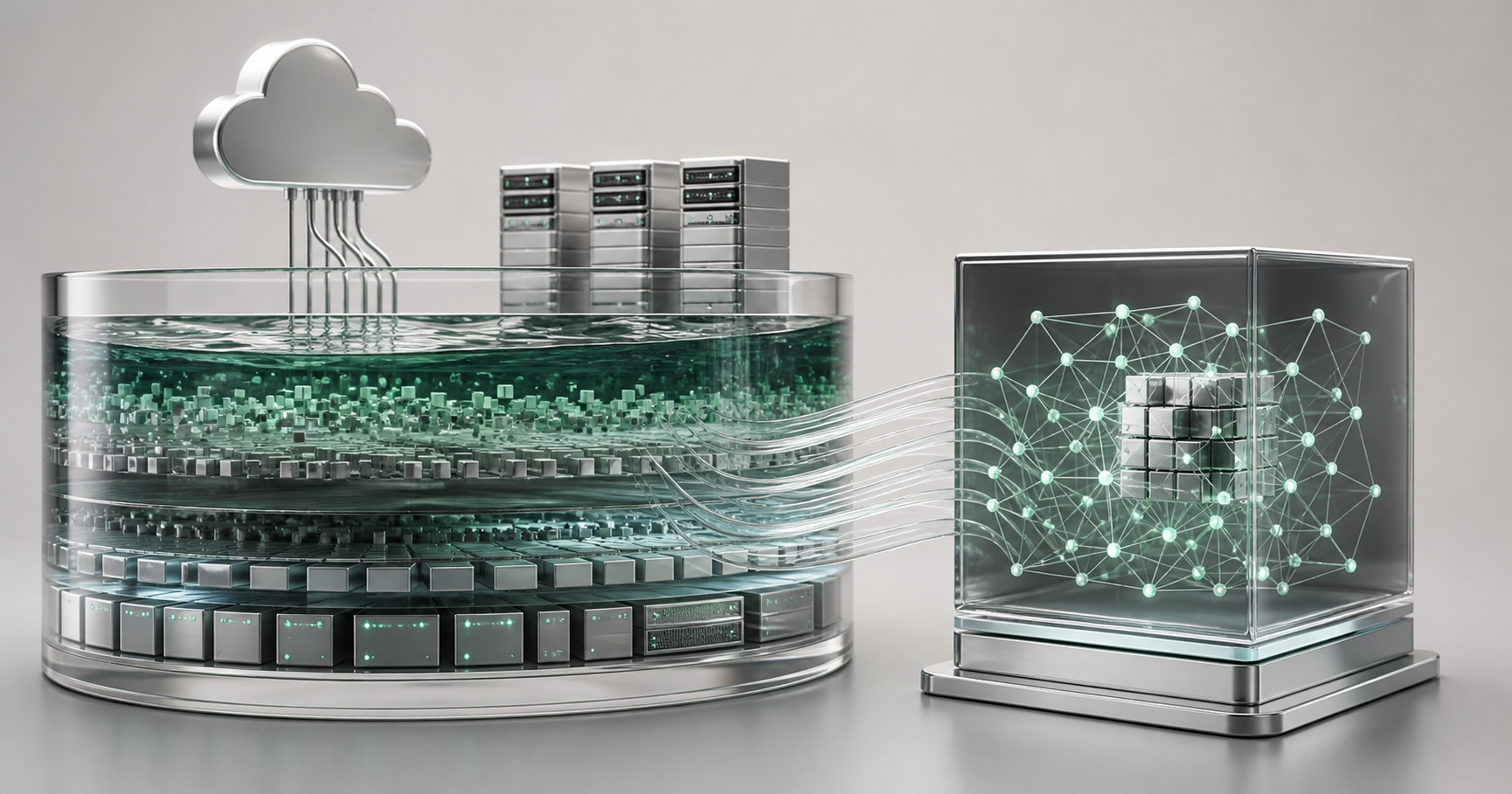
A datalake is a central place designed to store a huge amount of raw data just as it is, holding it there until you need it for something specific. It's like a massive, natural reservoir where you can pour all your business information—from neat spreadsheets to messy social media comments. You don't have to organize it perfectly before storing it; you can just dump it in and figure out what to do with it later.
Think of it this way: if a traditional database is like a filing cabinet where everything has to be sorted and labeled before it goes in, a datalake is more like a warehouse. You can throw everything in there—structured data, unstructured data, text files, images, videos, logs, whatever. It's all there, waiting for you to decide how to use it.
But here's what most people don't realize: datalakes aren't just storage. They're the foundation of modern AI. Without them, you can't really do serious AI work. With them, you have the raw material to build intelligent systems that can transform your business.
Why Datalakes Matter for Modern AI
Modern AI, especially machine learning, is hungry for data. The more data you have, the better your AI models become. But here's the problem: most businesses have data scattered everywhere. Some in databases. Some in spreadsheets. Some in email. Some in cloud services. Some in physical documents. Getting all that data together in a way that AI can use it? That's where datalakes come in.
The Data Problem Most Businesses Face
Most businesses are sitting on a goldmine of data, but they can't use it because it's locked away in different systems. Your CRM has customer data. Your accounting system has financial data. Your website has visitor data. Your social media has engagement data. Your email has communication data. Each system stores data in its own format, with its own structure. Getting it all together to answer a question or build an AI model? That's nearly impossible.
A datalake solves this by giving you one place to put everything. You don't have to figure out how to organize it first. You just collect it. Then, when you need it, you can access it, transform it, and use it for whatever you need—analytics, AI models, reporting, whatever.
"We had customer data in five different systems. Every time we wanted to analyse something, we had to export from each system, clean it up, combine it, and hope we got it right. It took weeks. Now with a datalake, all that data is in one place, and we can query it in minutes. It's changed everything."
That's from a client who was drowning in data but couldn't use it. The datalake didn't just store their data—it made it usable.
How Datalakes Actually Work
Understanding how datalakes work will help you see why they're so powerful for AI. It's not as complicated as it sounds.
The Storage Layer
At its core, a datalake is storage. But it's storage designed for massive scale. We're talking petabytes of data. It's typically built on cloud storage services like Amazon S3, Azure Data Lake Storage, or Google Cloud Storage. These services are designed to store huge amounts of data cost-effectively.
The key difference from traditional storage is that you don't have to structure the data before storing it. You can store:
- Structured data: Databases, spreadsheets, CSV files
- Semi-structured data: JSON, XML, log files
- Unstructured data: Text documents, images, videos, audio files
- Real-time data streams: Social media feeds, IoT sensor data, web logs
All of it goes in the same place, in its original format.
The Processing Layer
But storage alone isn't enough. You need to be able to process the data. That's where processing engines come in. Tools like Apache Spark, Hadoop, or cloud-native services can query and process data in the datalake without having to move it first.
This is important because moving petabytes of data is slow and expensive. Instead, you bring the processing to the data. The processing engine reads the data where it is, processes it, and gives you results.
The Access Layer
Finally, you need ways to access the data. This might be:
- SQL queries for structured data
- APIs for programmatic access
- BI tools for analytics and visualization
- Machine learning platforms for building AI models
- Data science tools for exploration and analysis
The datalake makes all your data accessible through these different interfaces, depending on what you need to do with it.
Why This Matters for AI
Here's where it gets interesting for AI. Machine learning models need training data. Lots of it. And they need it in a format they can use. A datalake gives you:
- Massive amounts of data: The more training data, the better the model
- Diverse data: Different types of data help models understand patterns better
- Historical data: Models learn from past patterns to predict future ones
- Real-time data: For models that need to adapt to current conditions
- Clean, accessible data: Data that's ready to use without weeks of preparation
Without a datalake, you're limited to whatever data you've already organized. With a datalake, you can collect everything and use what you need when you need it.
Real-World Use Cases
Let's look at how businesses are actually using datalakes for AI:
Customer Behaviour Analysis
A retail company collects data from their website, mobile app, in-store systems, social media, and customer service. They store it all in a datalake. Then they build AI models that analyse customer behaviour across all these channels to predict what customers want, when they want it, and how to reach them.
Predictive Maintenance
A manufacturing company collects sensor data from all their equipment, maintenance records, production logs, and environmental data. They store it in a datalake and build AI models that predict when equipment will fail, so they can fix it before it breaks.
Personalization
An e-commerce company collects browsing data, purchase history, search queries, reviews, and social media activity. They use their datalake to build AI models that personalise the shopping experience for each customer.
Fraud Detection
A financial services company collects transaction data, customer behaviour data, device information, and location data. They use their datalake to build AI models that detect fraudulent activity in real-time.
The pattern is the same: collect diverse data, store it in a datalake, use it to build AI models that solve business problems.
Building a Datalake: What You Need to Know
If you're thinking about building a datalake, here's what you need to consider:
Cloud vs On-Premise
Most datalakes today are built in the cloud. Why? Because:
- Scalability: Cloud storage scales automatically
- Cost: You pay for what you use
- Maintenance: The cloud provider handles infrastructure
- Integration: Cloud datalakes integrate easily with other cloud services
On-premise datalakes are possible, but they require significant infrastructure investment and ongoing maintenance. For most businesses, cloud is the way to go.
Choosing a Platform
There are several options
- Amazon S3 with AWS services: Good if you're already on AWS
- Azure Data Lake Storage: Good if you're on Microsoft's platform
- Google Cloud Storage with BigQuery: Good for analytics-heavy use cases
- Open-source solutions: Like Apache Hadoop or MinIO
The right choice depends on what cloud platform you're using, what tools you need, and your budget.
Data Governance
This is critical. A datalake can become a data swamp if you don't manage it properly. You need:
- Access controls: Who can access what data?
- Data cataloging: What data do you have and where is it?
- Data quality: Is the data accurate and reliable?
- Compliance: Does it meet regulatory requirements?
- Lifecycle management: When can you delete old data?
Without governance, your datalake becomes a mess that nobody can use.
Security Considerations
You're storing potentially sensitive data. Security is non-negotiable. You need:
- Encryption: Both at rest and in transit
- Access controls: Role-based access that limits who can see what
- Audit logs: Track who accessed what data when
- Compliance: Meet Australian privacy and data protection requirements
- Data residency: Know where your data is stored (Australian data centers matter)
Don't skimp on security. A data breach can destroy your business.
Cost Management
Datalakes can get expensive if you're not careful. Costs include:
- Storage: Based on how much data you store
- Processing: Based on how much you process
- Egress: Based on how much data you move out
- Services: Based on what tools and services you use
Monitor your costs. Set up alerts. Optimise your usage. A datalake should save you money by making data usable, not cost you a fortune in storage fees.
The Implementation Process
Building a datalake isn't something you do overnight. Here's a typical process
Phase 1: Planning
- Identify your data sources
- Define your use cases
- Choose your platform
- Plan your governance
- Estimate costs
Phase 2: Setup
- Set up storage
- Configure security
- Set up access controls
- Create data catalog
- Set up monitoring
Phase 3: Data Ingestion
- Connect data sources
- Set up data pipelines
- Start collecting data
- Validate data quality
Phase 4: Enable Access
- Set up query tools
- Connect BI tools
- Enable API access
- Train your team
Phase 5: Build AI Models
- Prepare training data
- Build and train models
- Deploy models
- Monitor performance
This process typically takes months, not weeks. But the investment pays off when you can actually use all your data.
Common Challenges and How to Overcome Them
Datalakes aren't magic. They come with challenges:
Data Quality
If you put garbage in, you get garbage out. You need processes to ensure data quality:
- Validation: Check data as it comes in
- Cleaning: Fix errors and inconsistencies
- Monitoring: Track data quality over time
- Documentation: Know what the data means
Without quality controls, your datalake becomes useless.
Complexity
Datalakes can be complex. You need:
- Skilled people: Data engineers, data scientists, analysts
- Good tools: Platforms that make it easier
- Clear processes: Defined workflows for common tasks
- Training: Make sure your team knows how to use it
Don't underestimate the complexity. Plan for it.
Cost Overruns
Costs can spiral if you're not careful:
- Monitor usage: Track what you're spending
- Optimise storage: Delete old data, compress data
- Optimise processing: Only process what you need
- Set budgets: Know your limits
Start small. Prove value. Then scale.
The Future of Datalakes and AI
Datalakes are evolving. We're seeing:
- Better integration with AI tools
- More automated data quality and governance
- Better performance and lower costs
- More user-friendly interfaces
- Better security and compliance features
The companies that build datalakes now will have a significant advantage. They'll have the data foundation to build AI capabilities that competitors can't match.
Getting Started
If you're thinking about building a datalake, start small. Pick one data source. Prove the concept. Show value. Then expand. Don't try to move everything at once.
The key is to start collecting data now, even if you don't know exactly how you'll use it. Because by the time you figure out what you need, you'll already have it. And that's the real power of a datalake—it gives you options you didn't have before.
For businesses looking to get serious about AI, a datalake isn't optional. It's the foundation. Without it, you're limited to whatever data you've already organized. With it, you have the flexibility to explore, experiment, and innovate. And in today's business environment, that flexibility is everything.